

Table of Contents
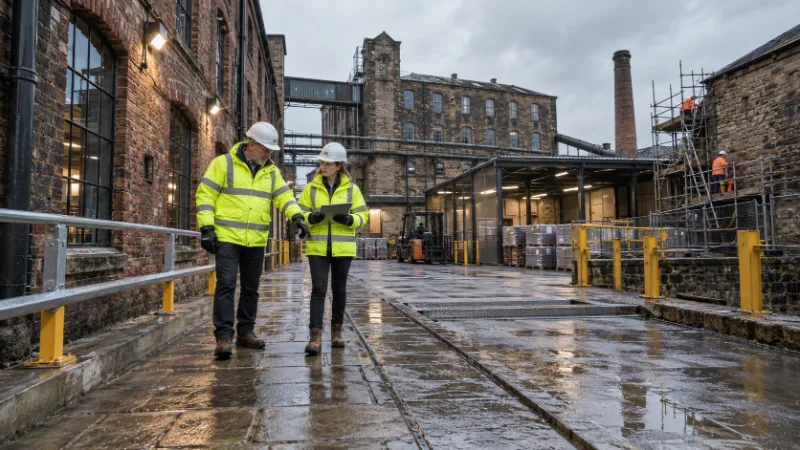
Yorkshire’s manufacturing heritage means many businesses operate from factories, warehouses and industrial premises that have been in use for decades.
While these buildings continue to support modern operations, their layouts weren’t necessarily designed for today’s machinery, delivery schedules or levels of vehicle movement.
As operations evolve, new safety risks can emerge. However, addressing these risks doesn’t always mean rebuilding, relocating or redesigning an entire facility.
By identifying problem areas and making targeted improvements, businesses can improve workplace safety while keeping disruption to a minimum, according to Chris Chauce, Managing Director of CT Safety Barriers, a supplier of Armco barriers.
Assess Your Site and Identify Potential Risks
Before making any changes, you need to understand how your site operates today and where the existing layout creates safety risks.
Chris Chauce said:
“Rather than treating the entire facility as a safety concern, focus on identifying specific areas where people, vehicles, machinery and infrastructure interact.”
A practical site assessment can include:
- Walking through the site during normal operations. Observe how vehicles, employees and equipment move around the facility.
- Mapping pedestrian and vehicle routes. Identify where people and vehicles share space, cross paths or pass through narrow openings. Look for blind corners, restricted visibility and areas where vehicles frequently reverse.
- Identifying vulnerable infrastructure. Check whether structural columns, warehouse doors, machinery or storage areas are exposed to vehicle movements.
- Speaking to employees. Forklift operators, warehouse staff and maintenance teams may know about awkward manoeuvres, near misses or problem areas that aren’t immediately obvious.
- Reviewing incident and maintenance records. Previous collisions and recurring damage can highlight where existing safety precautions may be inadequate.
- Assessing and prioritising the risks. Consider how likely an incident is, the potential consequences and whether existing controls are sufficient.
Plan Improvements Around How Your Site Actually Works
Once you’ve identified the risks, the next step is deciding how to address them with minimal disruption to daily operations.
In older industrial buildings, working around existing infrastructure is often more practical than changing it.
However, any improvements need to reflect how the site functions. Vehicle turning space, loading operations, maintenance access, pedestrian movements and emergency routes should all be considered before changes are introduced.
Protect Fixed Infrastructure Rather Than Trying to Move It
One of the challenges with older industrial buildings is that many structural features cannot easily be relocated.
As operations change, these features may become exposed to vehicle movements that weren’t anticipated when the building was designed.
Rather than undertaking extensive structural alterations, businesses can consider installing physical protection around these features.
Armco barriers are one option for protecting vulnerable infrastructure in industrial environments.
These steel barrier systems provide a physical buffer between moving vehicles and the features behind them, helping to reduce the risk of direct impact damage.
For example, barriers could be installed alongside vehicle routes to protect exposed structural columns, around vulnerable machinery or near loading areas where vehicles operate close to buildings.
Armco barriers can be manufactured in different lengths and configurations to accommodate existing layouts, helping businesses protect vulnerable areas without making major structural changes.
Where standard configurations aren’t suitable, bespoke manufacturing can help accommodate the constraints of an existing site.
Yorkshire-based CT Safety manufactures Armco barriers in-house, allowing dimensions and configurations to be adapted to individual site requirements.
Create Safer Separation Between People and Vehicles
As industrial operations change, pedestrian and vehicle routes can become increasingly difficult to manage.
A walkway that once saw occasional vehicle movements may now run alongside a busy forklift route.
Similarly, changes to storage arrangements or production processes might force employees to cross areas regularly used by vehicles.
Where pedestrians and moving vehicles share space, the consequences of a collision can be serious.
According to the HSE’s provisional figures for 2025/26, 24 workers in Great Britain were killed after being struck by moving vehicles, making it one of the leading causes of workplace fatalities.
Separating pedestrians from vehicles is therefore an important consideration when improving industrial site safety.
Depending on the layout and risks involved, measures could include:
- Dedicated pedestrian walkways: Establishing routes that keep employees physically separated from vehicle movements wherever possible.
- Physical safety barriers: Separating pedestrians from vehicle routes where impact protection is required.
- Safety handrails: Helping define pedestrian routes, guide movement and discourage access to vehicle areas. Standard handrails should not be relied upon for vehicle impact protection unless specifically designed and verified for that purpose.
- Floor markings and signage: Clearly identifying designated walkways, vehicle routes and crossing points.
- Designated crossings: Directing pedestrians towards appropriate locations with good visibility and suitable precautions.
The right approach depends on the frequency of vehicle movements, the space available and how employees need to access different areas of the site.
Small Changes Can Prevent Bigger Disruption
A forklift striking a warehouse door might initially appear to be an isolated issue. However, if the damage prevents the door from operating, it could also affect deliveries, restrict access and disrupt daily operations.
Similarly, damage to machinery or structural features may require an area to be taken out of use while repairs or safety assessments are carried out.
Installing suitable protection around vulnerable areas can help reduce the risk of these incidents and the wider disruption they may cause.
For businesses operating from older premises, these changes can often be considered individually and introduced in stages, rather than requiring a complete facility redesign.
This also means improvements can be tailored to the specific risks identified, rather than introducing unnecessary changes to areas that already operate safely.
Make Today’s Improvements Flexible Enough for Tomorrow
For businesses operating from older industrial premises, the starting point is to assess how the site is used today, rather than how it was originally designed to operate.
Identify where people and vehicles interact, where infrastructure is exposed to potential damage and whether existing safety measures are still effective.
From there, targeted improvements can be planned around the layout and day-to-day requirements of the facility.
Improving safety doesn’t always require a complete redesign. Often, it’s about making the right changes in the areas where they’re needed most.
Contact CT Safety Barriers today to make your sites safer on (01977) 666 818 or email sales@ctsafetybarriers.co.uk.