


Table of Contents
Every damaged delivery costs more than just the product.
You pay for the replacement, the return postage, and a second shipment. Then there is the part that matters most, the customer who decides not to order again. In many cases, the issue is not the courier. It comes back to the box.
By the end of this guide, you will know how to match your box to your product, your packing method, and the delivery journey it goes through. When those three things line up, damage stops showing up as a recurring problem.
Here is what actually makes the difference:
- Choosing the right box size
- Using the correct wall strength
- Packing to remove movement inside the box
- Preparing for the full delivery journey
What are the Core Strategies to Prevent Product Damage During Delivery?

Use the Right Box Size to Prevent Movement and Impact Damage
Most delivery damage starts with movement inside the box, and that usually comes down to size.
The problem is rarely a box that is too small. It is a box that is too big. When your product has around 40mm or more space on any side, it can shift during transit. That movement creates repeated impact, which leads to cracks, dents, or breakage.
One way to prevent that is to measure your product at its widest points in all three dimensions, then add 10 to 15mm on each side. This gives you a close fit without relying too much on void fill.
If you wrap the product first, measure it after wrapping so the sizing reflects how it is actually shipped.
If you are working with a varied product range, keep your box selection simple. Most ecommerce operations run efficiently with three to four standard sizes. Trying to force everything into one box usually leads to excess space, and that is where avoidable damage begins.
Choose the Correct Box Strength to Prevent Crushing and Breakage
The right size keeps products from moving, but strength is what protects them from external pressure.
Single-wall boxes, at around 3mm thick, are suitable for products under 5kg that are not fragile. They work well for items like clothing, stationery, and lightweight accessories, and they help keep overall parcel weight lower.
Double-wall boxes, at around 6mm thick, provide much better resistance to crushing and impact. They are the better option for heavier items, fragile products, or anything that may sit under other parcels for extended periods.
A quick check can help you spot issues early. Press firmly on the sides of your packed box. If it flexes easily, the structure is not strong enough for the weight inside it, and it is worth upgrading before sending more orders.
If you are sourcing from suppliers such as Priory Direct, who supply cardboard boxes for product protection, you will find both single and double-walled options designed for ecommerce shipping. These will help you to maintain consistent protection across your orders.
Pack Boxes Properly to Prevent Internal Movement During Transit
Even with the right box size and strength, poor packing will still lead to damage.
Most issues happen because the product moves inside the box. It only takes a small gap for repeated impacts to cause cracks or chipped edges, especially with fragile items.
The goal is to remove that movement completely.
Start by wrapping fragile products in at least two layers of bubble wrap and securing them so they cannot shift. Place the item in the centre of the box rather than against the sides, then fill all remaining space until everything feels firm and supported.
Before sealing, give the box a proper shake. If you hear or feel movement, open it, and add more fill. That final check is often what separates a safe delivery from a return.
Account for the Delivery Journey to Prevent Handling and Weather Damage
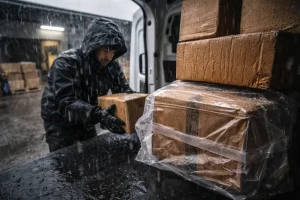
It is easy to pack for the product and forget about the journey, but the journey is where most stress happens.
Your parcel will move through vans, sorting systems, and depots before it reaches the customer. It may be stacked under other boxes or left outside for hours. Each step adds pressure, impact, or exposure.
If your deliveries involve multiple handling stages, it is worth adding extra internal protection and considering double-wall boxes, even for products that seem durable.
Moisture is another common issue that gets overlooked. A box left outside in wet conditions can weaken quickly, especially at the base. Placing your product inside a poly bag before boxing is a simple step that protects against that risk and costs very little per order.
Standardise Your Box Sizes to Prevent Inconsistent Packing and Returns
Inconsistent packaging is one of the most common reasons damage rates creep up over time.
As new products are added, they do not always fit existing boxes. When that happens, people tend to choose the closest available option, which often means too much space or the wrong level of protection.
A more reliable approach is to standardise your packaging across the range. Choose three to four box sizes that cover most of what you ship, ideally around 80 percent of your products.
For many ecommerce operations, it looks like a small box for compact items, a mid-size box for core products, and a larger box for bulkier orders. Small cardboard boxes often cover more of a product range than expected, especially for accessories and lightweight goods.
Once your sizes are set, every new product should fit one of them without excessive void fill. This keeps packing consistent and reduces the chances of damage slipping through.
How Different Box Types Protect Your Products in Transit?

| Box Type | Wall Thickness | Max Recommended Weight | Best For |
| Single wall | 3mm | Up to 5kg | Lightweight, non-fragile items |
| Double wall | 6mm | Up to 15kg | Fragile, heavy, or high-value products |
| Small cardboard boxes | 3 to 6mm | Up to 5kg | Compact ecommerce products, accessories |
| Large shipping boxes | 6mm | 15kg+ | Bulkier items, multi-product orders |
Better Box Decisions Mean Fewer Damaged Orders
Damage during delivery is not random. It usually comes down to three things: box size, box strength, or how the product was packed.
If you are seeing repeated issues, start with box size, then check wall strength, then review your packing process. In most cases, the problem sits in one of those areas.
Fix those, and the return rate follows.
FAQs
What’s the difference between single-wall and double-wall boxes?
Single-wall boxes have one fluted layer, around 3mm thick. Double-wall boxes have two layers, around 6mm thick, which gives much better protection for heavier or fragile items.
How do I know if my box is the right size?
Your product should fit with around 10 to 15mm of space on each side when packed. If you shake the box and feel movement, it is either too large or not filled properly.
What’s the best way to stop products from moving inside a box?
Wrap the item securely, place it centrally, and fill all gaps until nothing moves. A quick shake test before sealing confirms everything is secure.
When should I use small cardboard boxes instead of larger shipping boxes?
Use small boxes for items up to 5kg that fit within roughly 200 x 150 x 100mm when packed. Move to a larger box when more space or stronger construction is needed for safe transit.