


Table of Contents
Electric vehicles like the Cadillac LYRIQ offer a new level of personalisation for drivers not only in terms of performance and handling but also in how energy is consumed.
With a variety of driving modes designed to tailor your driving experience, one key question arises: do these modes actually affect battery usage and range? The answer is yes, and in this article, we’ll explore how and why.
What Are the Driving Modes Available in the Cadillac LYRIQ?
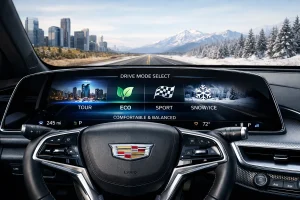
The Cadillac LYRIQ offers a range of driving modes designed to suit different driving styles, conditions and personal preferences.
These modes influence not only the driving feel but also how energy is used and recovered. Understanding what each mode does is essential for anyone aiming to optimise their battery usage and extend the vehicle’s range.
The available driving modes in the LYRIQ include:
- Tour Mode: The default setting focused on comfort and balanced performance.
- Sport Mode: Enhances responsiveness and acceleration for a dynamic drive.
- Snow/Ice Mode: Improves traction and control on slippery or low-grip surfaces.
- My Mode: Customisable settings for steering, suspension, acceleration and sound.
- One-Pedal Driving (OPD): Allows acceleration and deceleration using only the accelerator.
- Regen on Demand: Manual regenerative braking using a steering wheel paddle.
Each mode adjusts multiple parameters such as throttle sensitivity, steering feedback, and regenerative braking behaviour.
More aggressive modes like Sport increase energy demands, while efficiency-focused features like OPD and Regen on Demand aim to conserve or recapture energy during use.
How Does Tour Mode in the LYRIQ Maximise Range and Efficiency?
Tour Mode is the standard driving mode and is carefully tuned to offer a balanced experience that prioritises range and comfort.
It is designed to meet the needs of most driving scenarios, whether urban commutes, suburban traffic or motorway cruising.
When in Tour Mode, the LYRIQ regulates power delivery to avoid excessive acceleration and energy wastage.
The steering is lighter, and the throttle response is gentle, making it easier for drivers to maintain a steady pace and smooth driving habits. These characteristics directly translate to improved battery efficiency.
In addition, Tour Mode optimises the use of regenerative braking systems, especially when paired with One-Pedal Driving.
Energy recovered during deceleration is fed back into the battery, which enhances range over time.
Some key advantages of Tour Mode include:
- Smooth acceleration that avoids energy spikes
- Predictable regenerative braking
- Ideal for stop-start city traffic or long, uninterrupted trips
It is also worth noting that this mode is best used when the driver is aiming for consistency rather than performance.
It works particularly well when external conditions such as temperature and road type are stable, allowing the system to maximise energy efficiency.
Why Does Sport Mode in the LYRIQ Use More Battery Power?
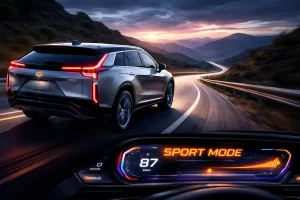
Sport Mode is tuned to offer a more thrilling driving experience. It sharpens the LYRIQ’s responsiveness, increasing the throttle sensitivity and tightening the steering feedback.
These changes are geared towards making the vehicle feel more dynamic and agile, particularly during acceleration or high-speed manoeuvres.
However, this performance boost comes at the expense of energy consumption. The vehicle delivers power more aggressively, which causes the battery to drain faster.
Regenerative braking may also be slightly reduced in effectiveness, as the system prioritises immediate responsiveness over efficiency.
When driving in Sport Mode, users may notice:
- Faster battery depletion
- Reduced estimated driving range on the dashboard
- More aggressive acceleration even with minimal pedal input
This mode is ideal for short bursts of spirited driving rather than long-distance travel. In real-world conditions, such as driving through hilly areas or overtaking on motorways, Sport Mode may offer a satisfying experience, but it should be used sparingly if the goal is to preserve battery life.
In terms of consumption, the difference between Tour and Sport Modes can be quite noticeable.
While exact figures vary based on terrain and driving style, users often report a 10% to 15% drop in available range when frequently using Sport Mode.
Can One-Pedal Driving Help Extend the LYRIQ’s Battery Range?
One-Pedal Driving is a feature that allows drivers to accelerate and decelerate using only the accelerator pedal.
When the driver lifts their foot off the pedal, regenerative braking is applied to slow the car down. This braking energy is converted back into electricity and stored in the battery.
The LYRIQ offers two levels of One-Pedal Driving:
- Normal Regen Level: Provides a milder deceleration and energy recovery effect
- High Regen Level: Offers stronger braking and more aggressive energy capture
This system is most effective in urban environments with frequent starts and stops. Rather than using traditional brakes, drivers can rely on the regenerative system to manage speed, which helps to reduce mechanical wear while also improving energy efficiency.
Key Benefits of One-Pedal Driving
- Enhances energy recovery during deceleration
- Reduces reliance on friction brakes
- Makes city driving smoother and more intuitive
Drivers report that One-Pedal Driving takes some getting used to but quickly becomes second nature. It also encourages smoother driving behaviours, which in turn leads to more efficient energy use.
Over longer journeys, especially those involving mixed traffic or variable speeds, One-Pedal Driving can contribute significantly to extending battery life.
How Does Regen on Demand Compare to One-Pedal Driving?
Regen on Demand is Cadillac’s manual regenerative braking system that operates separately from One-Pedal Driving.
It allows the driver to activate regenerative braking using paddles located behind the steering wheel, offering a more on-demand and controlled approach to energy recovery.
The primary difference between Regen on Demand and OPD lies in their usage:
- OPD is automatic and always active when engaged
- Regen on Demand requires manual input each time the driver wishes to slow down
This makes Regen on Demand better suited for moments when the driver anticipates a need to decelerate, such as approaching a junction, going downhill or navigating slow traffic.
Comparison Table
| Feature | One-Pedal Driving | Regen on Demand |
| Activation | Automatic (via drive mode) | Manual (steering paddle) |
| Regen Intensity Control | Normal / High levels | Variable based on paddle input |
| Usability | Best in city traffic | Ideal for hills and planned stops |
| Energy Recovery | Continuous | On-demand |
| Driver Adaptation | Quick learning curve | Requires timing and manual use |
By offering both options, the LYRIQ provides flexibility. Some drivers may prefer the simplicity of OPD, while others appreciate the control that Regen on Demand offers.
How Do Different Driving Behaviours Impact Battery Usage in the LYRIQ?
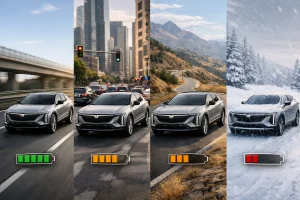
Beyond the driving mode selected, the behaviour of the driver plays a substantial role in determining how efficiently the LYRIQ uses its battery. Factors such as speed, acceleration, braking habits and environmental conditions all have an impact on range.
Common Behaviours That Increase Battery Usage
- Rapid acceleration or heavy throttle application
- Frequent hard braking instead of coasting or using regenerative systems
- Driving at consistently high speeds on motorways
- Running climate control systems at maximum settings, especially in winter
Behaviours That Improve Battery Efficiency
- Maintaining a consistent speed using cruise control
- Gradual acceleration and deceleration
- Making use of regenerative braking features
- Pre-conditioning the vehicle while charging
External factors such as wind resistance, tyre pressure and road gradient also influence efficiency. For example, driving uphill naturally requires more power, while descending with Regen on Demand can help recover energy.
Battery efficiency is a dynamic metric that changes in real time, meaning that adjustments in driving style can have immediate effects on remaining range.
Is There a Mode That Offers the Best Range for Long-Distance Driving?
When planning longer journeys, particularly in the UK where varying road conditions and traffic patterns are common, the most efficient strategy involves a combination of Tour Mode, One-Pedal Driving and appropriate use of cruise control.
Tour Mode provides a stable and efficient base. Its gentle throttle mapping ensures that power is delivered steadily, avoiding spikes in consumption.
This is particularly useful for motorway cruising, where sustained high speeds can quickly deplete battery reserves if not managed carefully.
Using One-Pedal Driving at high regen levels during slow-moving sections of a journey helps to recapture energy.
Similarly, Regen on Demand can be deployed when descending hills or approaching roundabouts.
To further enhance long-distance efficiency, consider the following:
- Set a moderate motorway speed (e.g., 60–65 mph) to reduce wind resistance
- Pre-plan charging stops to avoid range anxiety
- Avoid sudden overtakes or aggressive acceleration
Combining these methods with the right driving modes creates a controlled environment for optimising range.
On flat terrain with consistent use of Tour Mode, it is possible to match or even exceed the manufacturer’s estimated WLTP range.
How Do Cadillac LYRIQ Driving Modes Compare to Other Electric Vehicles?
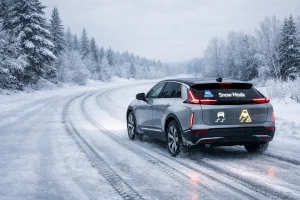
Cadillac’s approach to driving modes in the LYRIQ is competitive within the electric vehicle market, especially when compared to similarly priced SUVs from brands like Tesla, Audi and BMW.
While each manufacturer offers a set of features that aim to enhance range, performance or handling, the LYRIQ balances these elements with a strong focus on efficiency and customisation.
Comparison Table: Driving Mode Features by Brand
| Feature | Cadillac LYRIQ | Tesla Model Y | Audi Q4 e-tron |
| Standard Efficiency Mode | Tour | Chill | Efficiency |
| Performance Mode | Sport | Sport / Track | Dynamic |
| Regen Customisation | OPD / Paddle | Auto / Manual | Fixed Levels |
| Custom Mode | My Mode | Custom Profiles | Drive Select |
| Real-Time Range Feedback | Yes | Yes | Yes |
Cadillac’s combination of automatic and manual regen systems, along with the My Mode feature, gives drivers an extra level of control.
This is particularly valuable in the UK market where roads are diverse and range-conscious consumers demand flexibility.
The LYRIQ’s interface also clearly communicates how changes in driving behaviour or mode selection impact estimated range. This transparency helps drivers make better real-time decisions to manage battery life.
Conclusion
Yes, the Cadillac LYRIQ’s driving modes have a direct impact on energy consumption and driving range.
Modes like Sport provide exhilarating performance but use more battery power, while Tour Mode and features like One-Pedal Driving and Regen on Demand help conserve energy and extend range.
FAQs About Cadillac LYRIQ Driving Modes and Battery Efficiency
What is the most efficient way to drive a Cadillac LYRIQ?
The most efficient method is to use Tour Mode combined with One-Pedal Driving set to High regeneration, while maintaining steady speeds and avoiding rapid acceleration.
Does driving uphill impact the LYRIQ’s battery range significantly?
Yes, climbing steep gradients increases power demand, which can reduce range faster than on flat roads. Regenerative braking on descents helps to recover some energy.
Can you switch driving modes while the vehicle is in motion?
Yes, the LYRIQ allows seamless switching between modes while driving, letting you adapt to changing road or weather conditions on the go.
Is One-Pedal Driving suitable for motorway use?
One-Pedal Driving is most effective in urban or stop-and-go conditions. On motorways, traditional driving with Regen on Demand may offer a smoother experience.
How does cold weather affect battery usage in the LYRIQ?
Cold temperatures reduce battery efficiency, which can lower driving range. Pre-conditioning the vehicle while plugged in helps mitigate this effect.
Can I customise driving behaviour in the LYRIQ?
Yes, the My Mode setting allows customisation of steering, acceleration, and regen characteristics to suit personal preferences.
Is there a learning curve for using regenerative braking features?
While it may feel different initially, most drivers adapt quickly. OPD and Regen on Demand become intuitive with use and improve overall driving efficiency.