


Table of Contents
Running a vacation rental portfolio gets complicated faster than most operators expect. At 5–10 properties, manual processes still work. Messages get answered, calendars get updated, and tasks get assigned without too much friction.
At 20+ properties, that no longer works. Guest communication overlaps, cleaning schedules get harder to track, and small errors start showing up in reviews and lost bookings.
At that point, keeping communication, scheduling, and operations aligned usually depends on some level of vacation rental automation.
What Does Vacation Rental Automation Actually Mean?
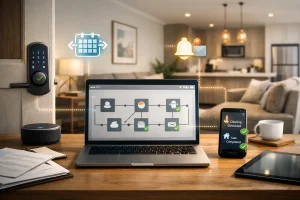
Vacation rental automation refers to using systems and tools to handle repetitive operational tasks across bookings, communication, pricing, and team coordination.
In practice, this means fewer manual steps. Messages are sent automatically, calendars update in real time, and tasks are triggered based on booking activity instead of being assigned manually.
There’s a difference between partial and full automation. Partial automation might cover messaging or calendar sync, while full automation connects the entire workflow, from booking confirmation to cleaning scheduling and owner reporting.
Not everything can or should be automated, though. Guest interactions that require judgment, issue resolution, and relationship management still need human input. Automation works best when it handles volume, while teams focus on decision-making.
Why Automation Matters for Vacation Rental Managers?
Manual operations don’t fail all at once. They break under pressure. As booking volume increases, the time spent on repetitive tasks grows quickly.
Responding to guest messages, updating calendars, assigning cleaning tasks, and tracking performance across platforms can take up a significant part of the day.
That time has a cost. It limits how many properties a vacation rental manager can handle and increases the risk of errors.
Automation affects guest experience as well. Faster responses, consistent communication, and fewer operational gaps lead to better reviews. When processes are predictable, the experience becomes more reliable.
There’s also a direct link to scalability. Without automation, growth adds workload. With automation, growth becomes manageable because systems handle the repetitive parts.
Step-by-Step Guide to Automating Your Vacation Rental Business

Step 1 – Audit Your Current Workflows
Automation starts with understanding what already exists.
Map out every repetitive task across your operation. This includes guest communication, calendar updates, pricing changes, cleaning coordination, and reporting.
Look for areas where:
- Tasks are repeated frequently
- Errors tend to happen
- Time is spent coordinating between systems
Prioritise what to automate first. High-volume and error-prone processes usually deliver the most immediate impact.
Step 2 – Choose the Right Property Management Software
Automation depends on the system behind it. Vacation rental property management software should centralise operations rather than split them across tools.
Key features to look for include:
- Unified inbox for guest communication
- Automated messaging workflows
- Task triggers for operations
- Owner reporting and financial tracking
RentalReady brings these into one platform, allowing property managers to manage bookings, communication, and operations without switching between systems.
Step 3 – Automate Guest Communication
Guest communication is one of the highest-volume tasks in any short-term vacation rental operation.
Automation can cover:
- Pre-booking responses
- Pre-arrival instructions
- Check-in details
- During-stay support messages
- Post-stay follow-ups
Using AI tools, such as RentalReady’s Maia, helps handle large volumes of messages while maintaining a consistent tone.
Review requests and responses can also be automated, ensuring every guest interaction is followed up on without manual effort.
Step 4 – Automate Pricing and Channel Management
Pricing and availability need to stay aligned across all platforms.
Automation here includes:
- Syncing availability and rates across OTAs in real time
- Integrating pricing tools like Pricelabs, Beyond, or Wheelhouse
- Updating calendars automatically to avoid double bookings
This removes the need for manual updates and reduces the risk of inconsistencies across platforms.
Step 5 – Automate Cleaning and Maintenance Scheduling
Cleaning and maintenance coordination often relies on manual communication. Automation allows tasks to be triggered automatically based on bookings.
- Cleaning tasks are scheduled immediately after checkout
- Teams receive real-time updates through staff apps
- Quality control tools like Breezeway or Properly can be integrated
Property maintenance for serviced apartments also benefits from this approach, as recurring checks and tasks can be scheduled without manual tracking.
Step 6 – Automate Check-In and Access
Guest access is another area where automation reduces coordination.
- Smart locks and keyless entry systems allow self-check-in
- Door codes can be generated and sent automatically
- Digital guides provide instructions without manual input
This reduces the need for in-person coordination while improving the guest experience.
Step 7 – Automate Owner Reporting and Payouts
Owner communication is often overlooked in automation.
Automation here includes:
- Generating invoices and owner statements after each booking
- Providing owner portals where performance can be tracked
- Sharing data on bookings, income, and reviews
Transparency improves trust and helps retain property owners over time.
What Does Automation Actually Cost and What Does It Save?
Automation requires investment, usually in vacation rental software and integrations. However, the cost of manual operations is often higher.
- Time spent per property per month on manual tasks
- Staff costs for coordination and communication
- Errors that lead to lost bookings or poor reviews
With full automation, the time per property decreases, allowing managers to handle more listings without increasing workload.
The ROI becomes clear when comparing:
- The cost of software for vacation rentals vs.
- The cost of manual labour and inefficiency
For most operators, automation reduces operational cost per property while increasing revenue potential.
Tips to Scale Your Vacation Rental Business Through Automation
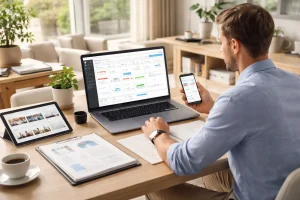
Scaling through automation works best when it’s structured properly:
- Build SOPs before automating them. Automating unclear processes usually leads to inconsistent results.
- Start with high-volume tasks like messaging and calendar management, then expand automation across operations.
- Use automation to free up your team for work that requires judgment, such as guest relationships and owner communication.
- Provide owner portals and reporting tools to improve transparency and attract new property owners.
- Use portfolio-level data to identify trends and make decisions across multiple vacation home rental listings.
The Bottom Line
Vacation rental automation is not about replacing people; it just removes the repetitive work that limits how a business grows.
A well-automated setup makes it possible to manage more properties, reduce errors, and improve guest experience all at the same time.
If you’re looking to build that kind of operation, start with one workflow, automate it, and expand from there. RentalReady is built to support that process, helping you turn disconnected tasks into a system that scales with your business.