

Table of Contents
Window blinds are not the first thing most landlords think about when preparing a rental property. Boilers, electrics, damp, and structural maintenance occupy the priority list for obvious reasons, they generate the complaints that trigger repair costs and the disputes that complicate tenancy endings.
Blinds sit somewhere below all of that in the mental hierarchy of landlord responsibilities, which is precisely why so many rental properties have blinds that are either missing, broken, or so inadequate that tenants replace them immediately and store the landlord’s original product in a wardrobe for the duration of the tenancy.
The practical and financial case for getting blinds right in a rental property is stronger than most landlords realise.
The right blind choice reduces tenant complaints, reduces replacement frequency, creates a deposit liability issue for tenants rather than landlords, and contributes to the energy efficiency credentials that increasingly affect both rental values and compliance requirements.
The wrong choice generates a recurring cost that compounds over multiple tenancy cycles while adding nothing to the property’s appeal at letting.
Why Is Blinds Safety in Rental Properties Important for UK Landlords?
The Regulatory Position: What Landlords Are Actually Required to Provide?

The first question most landlords ask is whether they’re legally required to provide window blinds at all. The short answer is no, there is no specific statutory requirement for landlords in England, Wales, or Scotland to provide window coverings as part of a residential tenancy.
The longer answer is more nuanced. Landlords are required under the Homes (Fitness for Human Habitation) Act 2018 to ensure that properties are free from category one hazards under the Housing Health and Safety Rating System.
Excessive cold, a category one hazard in some circumstances, can be connected to inadequate thermal protection at windows, particularly in bedrooms with large glazed areas.
The connection between absent window coverings and a fitness for habitation claim is indirect and unlikely to succeed on its own, but it forms part of the broader thermal adequacy picture that the Act encompasses.
More directly relevant is the implied obligation under common law that a rented property is habitable.
A bedroom window facing a neighbouring property with no blind or curtain provided creates a privacy issue that, while not generating automatic legal liability, creates the kind of tenant dissatisfaction that leads to early termination requests and negative reviews on rental platforms that increasingly affect void periods.
The practical position for most landlords is that blinds in rental properties are a commercial decision rather than a legal obligation, but one where the commercial case for providing adequate window coverings is considerably stronger than the case for omitting them.
The Child Safety Obligation: This One Is a Legal Requirement
Where the legal position becomes unambiguous is child safety and window blind operating cords.
UK regulations updated in 2023 require that any looped operating cord on a blind sold for use in a domestic setting either incorporates a breakaway safety connector, a fitting that releases under load if a loop forms around a child’s neck, or is secured by a fixed cord cleat that keeps the loop inaccessible.
The previous guidance was exactly that: guidance. The current requirement is regulatory and applies to blinds installed in properties where children under 18 may be present.
For landlords, this creates a specific obligation. Any blind with a looped operating cord, which includes most chain-operated roller blinds, Venetian blinds, and Roman blinds, must have either a compliant breakaway connector or a correctly positioned cord cleat fixed to the wall at a minimum height of 1.5 metres from the floor.
A cord cleat that is supplied with the blind but left in the box, or fixed at an accessible height, does not meet the requirement.
The practical implication is that landlords fitting or retaining blinds with looped cords need to verify that the safety components are correctly installed, not merely present.
A section 21 notice or deposit dispute that references a cord safety non-compliance creates a potential liability that the initial cost of compliant installation or replacement would have avoided entirely.
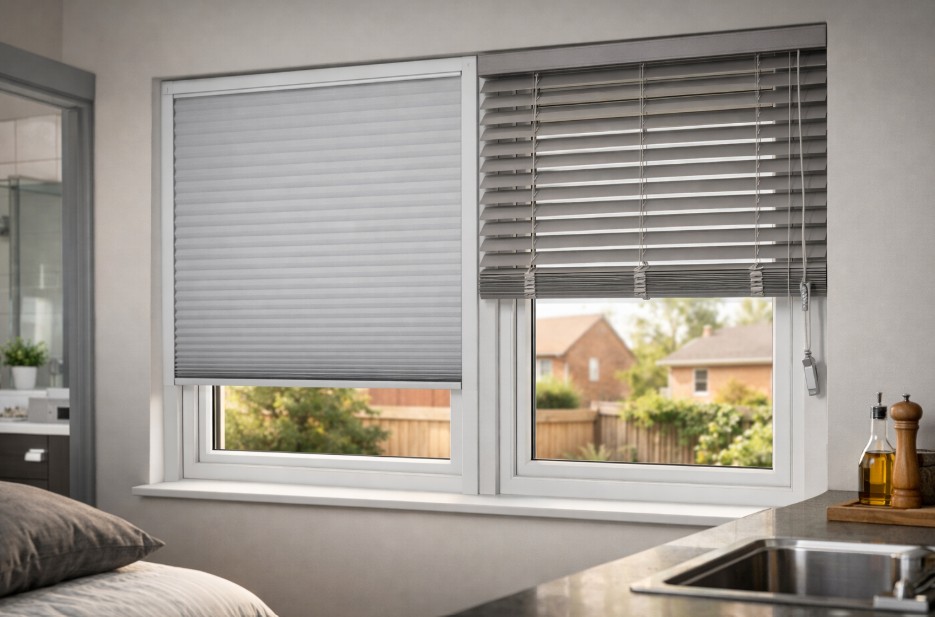
The simplest solution, and the one that eliminates the cord risk entirely rather than managing it, is to specify cordless blind formats wherever practical. Cordless perfect fit honeycomb blinds operate by pressing the bottom rail rather than pulling a cord.
There is no loop accessible at any height, the safety obligation is met structurally rather than through accessory management, and the product requires no cord cleat installation and no ongoing compliance checking between tenancies.
The No-Drill Advantage: Why It Changes the Landlord Calculation?

The most significant product development for the landlord context in the past decade is the perfect fit no-drill blind system for UPVC windows, and the majority of rental properties in the UK have UPVC windows, given that the rental stock skews heavily toward post-1980s housing where UPVC replacement windows are standard.
The perfect fit system clips into the UPVC glazing bead, the rebated channel that holds the glass within the frame, with no screws into the surrounding wall or ceiling.
Installation takes minutes per window. Removal is equally simple. The blind achieves edge-to-edge coverage of the glass without the bracket holes in the wall above the window that conventional mounting requires.
For landlords, the no-drill advantage operates on both sides of the tenancy.
- At installation: No holes in freshly decorated walls. No requirement for a separate tradesperson to drill and plug. No misaligned bracket holes that accumulate across multiple tenancy cycles as blinds are replaced and brackets repositioned. The landlord installs quality blinds at the start of the tenancy without creating fixings that complicate future redecoration or that look tired as the room ages.
- At tenancy end: When a tenant has damaged or removed a conventionally mounted blind, the landlord is left with bracket holes to fill, paint to touch up, and new blind installation that creates new holes. When a perfect fit blind is damaged or removed, replacement involves clipping a new blind into the existing frame. The frame itself is undamaged. No redecoration is required. The replacement cost is the blind only.
The cumulative saving across multiple tenancies in a single property makes the modest premium of quality perfect fit blinds over budget bracket-mounted alternatives straightforwardly cost-effective within the first tenancy renewal.
Tenant Behaviour and Blind Durability: What Actually Breaks?
Landlords who have managed rental properties for more than a few years develop a familiar relationship with blind failure modes. Understanding what actually breaks, rather than what looks premium in a product photograph, determines which products are worth specifying.
Operating Mechanisms
The operating mechanism is the component that fails first in the vast majority of blind failures in rental properties. Spring rewind mechanisms in roller blinds lose tension under repeated daily use and eventually fail to retract, leaving the fabric hanging in a permanently partially-lowered position.
Chain clutch mechanisms in roller and Venetian blinds develop slippage that means the blind won’t hold at any set position. Tilt mechanisms in Venetian blinds strip under heavy-handed operation and leave the slats stuck at a fixed angle.
The correlation between mechanism quality and operating life is strong enough that landlords who have replaced budget blinds after every tenancy and invested once in quality mechanisms consistently report significantly lower total replacement costs over a five-year period.
Chain mechanisms in general outperform spring rewind mechanisms for rental durability. Chain mechanisms have fewer moving parts subject to fatigue, hold the blind at any set position without relying on spring tension, and when they do fail, typically fail with an audible change in operation rather than suddenly. Spring mechanisms fail without warning and are rarely repairable, the entire blind must be replaced.
Slat and Fabric Damage
In Venetian blinds, individual slat damage, bending, creasing, breakage, is the most common physical failure. Budget Venetian blinds use thin aluminium slats that bend permanently under very modest lateral force.
A blind with two or three bent slats in the middle of the run looks damaged and reads as neglect at checkout even if the blind is otherwise functional.
Heavier gauge aluminium slats and timber slats in wooden Venetian blinds resist bending considerably better than budget aluminium.
The initial cost difference between a budget aluminium Venetian and a quality aluminium or timber equivalent is typically recovered in a single tenancy cycle where the budget product requires replacement and the quality product does not.
For roller blinds, fabric damage, tears, stains, and the coating degradation that produces pinholes in blackout fabric, is the primary failure mode. Waterproof-coated fabrics used in bathroom and kitchen locations degrade faster when tenants clean them with solvent-based household sprays that attack the coating.
Specifying fabric type by room, waterproof PVC roller for bathrooms, quality coated blackout for bedrooms, basic light-filtering roller for living areas, distributes the replacement cycle rather than having all blinds fail simultaneously.
Room-by-Room Specification for Rental Properties
Bedrooms
Bedroom blinds generate the most tenant dissatisfaction when inadequate and the most positive feedback when done correctly. The specific problem in UK bedrooms, particularly east-facing rooms in summer, is early morning light intrusion.
A tenant who cannot sleep past 4:30am in June because the bedroom blind admits light through gaps at the sides is a tenant who contacts the landlord, leaves negative reviews, and in some cases cites the issue in early termination correspondence.
The specification that eliminates this problem entirely on UPVC windows is a perfect fit honeycomb blackout blind. The clip frame eliminates side gaps structurally, not through careful hanging or adequate overlap, but because the blind occupies the same space as the glass within the frame geometry.
The blackout fabric eliminates light transmission through the material. The cellular construction provides thermal insulation that, as an incidental benefit, contributes to the room’s compliance with energy efficiency expectations.
The cost of a quality perfect fit blackout blind per bedroom window, typically £65 to £110 for a standard casement, is a landlord cost that pays for itself in the tenant satisfaction, reduced complaint frequency, and energy efficiency contribution it generates over the first tenancy alone.
Bathrooms
Bathroom blinds are the most frequently replaced in rental properties, almost always because the wrong material was specified. Fabric roller blinds in bathrooms absorb moisture, develop mildew, and are typically replaced within 18 months of installation. Real wood Venetian blinds in bathrooms warp within a similar timeframe as moisture penetrates the finish at slat edges and end grain.
The correct specification for a rental bathroom window is a PVC or aluminium Venetian blind with nylon monofilament ladder tape, the tape specification is the detail that determines whether the blind develops mildew at the base regardless of the slat material’s moisture resistance.
A waterproof roller blind in a PVC-coated fabric with no exposed textile backing is the alternative specification where a simpler operating format is preferred.
Neither real wood nor standard fabric belongs in a rental bathroom. The replacement cost when they fail is the penalty for the initial specification error, and the error is entirely avoidable.
Living Rooms and Kitchen-Diners
Living room blinds in rental properties benefit from being considered rather than merely present. A room that looks well-specified at viewings, with quality window treatments rather than the tired roller blinds that are the default in much of the rental market, commands a viewing-to-let conversion rate that reflects the quality of the overall presentation.
Faux wood Venetian blinds in a neutral finish provide the visual warmth of timber, which photographs and presents better than aluminium or plain white roller alternatives, with the moisture resistance that kitchen environments require.
For a kitchen-diner where the blind is in a dining zone away from direct cooking steam, a faux wood Venetian in a finish that relates to the kitchen cabinetry elevates the specification without introducing the moisture management problem that real wood creates in the same position.
Kitchens Above Cooking Areas
For windows directly above or near hobs, the specification is aluminium Venetian in a plain anodised or powder-coated finish. Grease accumulation in kitchen environments is unavoidable and accelerates material degradation in anything with a porous surface or textile component.
Aluminium wipes clean in seconds with a damp cloth and degreasing agent, and the anodised surface doesn’t degrade under cleaning agents the way fabric coatings, wood finishes, and PVC prints do.
The Energy Efficiency Dimension

EPC ratings and energy efficiency requirements are an increasingly active area of rental property regulation. The current minimum EPC requirement for rental properties in England and Wales is Band E, with government consultation on raising this to Band C having been ongoing, and the direction of travel clearly toward more stringent minimum standards.
Window treatments contribute to a property’s thermal performance, and while they are not formally assessed in the EPC methodology, they affect the lived thermal performance of the property in ways that are relevant to tenant satisfaction and to the broader energy efficiency picture.
Honeycomb blinds in perfect fit frames provide meaningful insulation at the window surface, the cellular structure traps still air between glass and room, reducing both heat loss in winter and solar heat gain in summer.
In a property with older double glazing that falls short of current thermal performance standards, a honeycomb blind on each bedroom window provides a thermal improvement at the glazing surface that costs significantly less than window replacement while contributing to the room’s thermal comfort in a way that is noticeable to tenants.
This is not a substitute for adequate glazing specification, it is a supplementary measure that improves the thermal performance of adequate glazing in a cost-effective way. For landlords managing properties where window replacement is not currently planned, it is the thermal intervention with the most favourable cost-to-impact ratio available.
What to Tell Tenants About the Blinds?
The detail that most landlords overlook and that would prevent the majority of operating mechanism failures in rental properties is tenant instruction.
Blinds that are operated incorrectly, roller chains pulled at the wrong angle, Venetian tilt mechanisms operated while the blind is half-raised and under tension, perfect fit bottom rails pushed upward rather than the cord operated, fail faster than blinds that are operated correctly.
A brief written instruction left in the property, one paragraph per blind type, explaining the correct operating sequence, reduces mechanism failure rates noticeably.
For perfect fit blinds specifically, noting that the clips disengage cleanly for removal and should not be forced prevents the clip damage that is the most common failure mode for the system and the only replacement cost that arises when the blind itself is undamaged.
Photographing the blinds at check-in as part of the inventory, noting the condition of each slat, the mechanism function, and the cord safety compliance, establishes the baseline against which checkout condition is assessed.
Blind damage that cannot be attributed to normal wear and tear, and that is documented against a clear check-in inventory, is appropriately chargeable to the tenant’s deposit.
The Landlord Calculation in Summary
The financial logic for quality blind specification in rental properties is not complicated.
Budget blinds installed at the start of a tenancy require replacement every one to two tenancies, at a combined cost, product, installation labour or contractor, redecoration of bracket holes, that typically exceeds the original installation cost twice over within five years.
Quality blinds, correctly specified for the room’s requirements, last three to five tenancies with standard maintenance.
The no-drill perfect fit system eliminates the redecoration component of replacement entirely, which is frequently the largest single cost in blind replacement in a conventionally mounted installation.
The clip frame remains in the window. Only the blind mechanism is replaced if damaged. The wall above the window is never touched.
Beyond the direct cost calculation, the tenant satisfaction benefit of a well-specified property, including window treatments that work correctly, provide genuine blackout in bedrooms, and look considered rather than functional-minimum, contributes to longer tenancies, fewer void periods, and the reduced advertising and referencing costs that longer tenancies produce.
Window blinds are not a glamorous landlord investment. They are, however, one of the few property improvements where the return on specification quality is calculable, reliable, and typically faster than any other fabric or finish investment in the same property.