

Table of Contents
If you are wondering when you will receive your LCWRA first payment after a decision, the direct answer is that it usually arrives in your next Universal Credit payment after completing three full assessment periods.
The decision itself does not trigger immediate payment. Instead, the amount is calculated from when your waiting period ends and is often paid with backdated money included.
Key takeaways:
- LCWRA payments start after three full assessment periods
- The first payment is made in your next Universal Credit cycle
- The decision date does not affect the payment start date
- Most claimants receive backpay as a lump sum
- Delays can occur due to fit note gaps or processing issues
When Do You Get Your LCWRA First Payment After a Decision?

If a claimant has recently been awarded LCWRA, the first payment does not arrive immediately after the decision is made.
The timing depends on how Universal Credit assessment periods work rather than the date of the decision itself.
In most cases, the first LCWRA payment is included in the next scheduled Universal Credit payment after the waiting period has been completed.
The system is designed so that payments follow a structured monthly cycle. This means that even if a claimant receives confirmation of LCWRA, the financial element is processed in alignment with their existing Universal Credit payment schedule.
To understand the LCWRA first payment after decision, it is important to recognise that the award is applied retrospectively.
This means the Department for Work and Pensions calculates entitlement from the correct assessment period rather than the date the decision letter is issued.
Many claimants assume that once the decision is made, payment will follow immediately. In reality, there is often a delay between the decision and the actual payment. This delay is not a loss of entitlement but simply part of the Universal Credit structure.
A benefits adviser explained this clearly:
“I often speak to people who think the money should arrive straight after the decision. The system does not work that way. The entitlement is already there, but the payment follows the monthly cycle.”
This distinction is crucial because it helps claimants understand why there may be a waiting period even after approval.
The first payment is not delayed in terms of entitlement, but it is scheduled according to the Universal Credit system.
What Is the Standard Waiting Period for LCWRA?
The standard waiting period for LCWRA is three full Universal Credit assessment periods. This begins from the date the claimant first reports their health condition and provides medical evidence, usually in the form of a fit note.
This waiting period is sometimes misunderstood as a delay or administrative hold. In reality, it is a built-in rule that applies to most LCWRA claims.
During this time, claimants continue to receive their normal Universal Credit payments without the LCWRA element.
Once the three full assessment periods have been completed, the LCWRA element becomes payable from the start of the fourth assessment period.
What Counts as an Assessment Period in Universal Credit?
An assessment period is a fixed one month cycle used to calculate Universal Credit payments. It is unique to each claimant and is based on the date they first made their claim.
The structure of an assessment period can be understood as follows:
| Component | Explanation |
| Start date | The date the Universal Credit claim began |
| End date | One month later, minus one day |
| Payment date | Usually seven days after the assessment period ends |
| Purpose | To calculate income, entitlement, and additional elements |
For example, if a claim starts on the 10th of January, each assessment period will run from the 10th of one month to the 9th of the next month.
This fixed cycle is important because LCWRA payments are aligned with these periods rather than calendar months.
Why Is There a 3-Month Waiting Period?
The three-month waiting period exists to ensure that LCWRA is awarded to individuals with long-term or ongoing health conditions that significantly limit their ability to work.
From a policy perspective, this waiting period allows time for:
- Medical evidence to be reviewed
- Work Capability Assessments to be conducted
- The claimant’s condition to be evaluated over time
A welfare specialist described the reasoning behind this rule:
“The waiting period is there to distinguish between short term illness and long term limitations. It ensures that the support is targeted correctly.”
Although this waiting period can feel lengthy, it is a standard part of the process and applies to the majority of claimants.
Does the LCWRA Decision Date Affect When You Get Paid?

The LCWRA decision date does not directly determine when a claimant will receive their first payment. This is one of the most common misunderstandings within the Universal Credit system.
Instead of using the decision date, the Department for Work and Pensions calculates entitlement based on when the waiting period ends. This means that even if a decision is made later, payments are still calculated from the appropriate assessment period.
To clarify how this works, consider the following table:
| Scenario | Outcome |
| Decision made before waiting period ends | Payment starts after waiting period |
| Decision made after waiting period ends | Payment is backdated |
| Decision delayed by several months | Arrears included in next payment |
| Decision made quickly | No early payment before waiting period |
This structure ensures that claimants receive the correct amount, even if administrative delays occur.
A welfare adviser shared practical insight:
“I have seen many cases where the decision came months later. People worried they had lost money, but when the payment arrived, it included everything owed from the correct date.”
This reinforces the idea that the system prioritises accuracy over speed when calculating LCWRA payments.
When Will You Actually Receive Your First LCWRA Payment?
The first LCWRA payment is usually received as part of the claimant’s next Universal Credit payment after the fourth assessment period begins.
Because Universal Credit is paid monthly in arrears, there is always a gap between when entitlement starts and when the money is received.
How Universal Credit Payment Dates Work?
Universal Credit payments follow a consistent pattern based on assessment periods.
| Stage | Timing |
| Assessment period ends | Day 30 or 31 of the cycle |
| Payment processed | Shortly after the assessment |
| Payment received | Around 7 days later |
This means that even when LCWRA entitlement begins, the payment will not be issued until the next scheduled payment date.
When is LCWRA added to Your Monthly Payment?
Once the waiting period has passed, the LCWRA element is automatically added to the claimant’s Universal Credit award.
The payment includes:
- The monthly LCWRA amount
- Any backdated arrears owed
- Adjustments based on assessment periods
The timing can sometimes create confusion, especially when the decision arrives shortly before a payment date. In such cases, the LCWRA element may not appear until the following month.
Can You Get LCWRA Backpay, and How Is It Calculated?

Backpay is a key part of the LCWRA payment process. Most claimants receive arrears because decisions are often made after the waiting period has already ended.
Backpay is calculated based on the number of assessment periods that have passed since the end of the waiting period.
The structure of backpay calculation can be illustrated below:
| Factor | Description |
| Waiting period end date | Determines start of entitlement |
| Number of missed payments | Counts months owed |
| Monthly LCWRA rate | Used to calculate total |
| Total arrears | Lump sum paid in one instalment |
For example, if a claimant is owed three months of LCWRA payments, the total backpay will equal three times the monthly LCWRA rate.
A caseworker explained this process:
“When the decision is delayed, the system calculates everything automatically. The claimant receives a lump sum that covers all missed payments.”
This ensures that no entitlement is lost due to processing delays.
What Is an Example Timeline for LCWRA Payments?
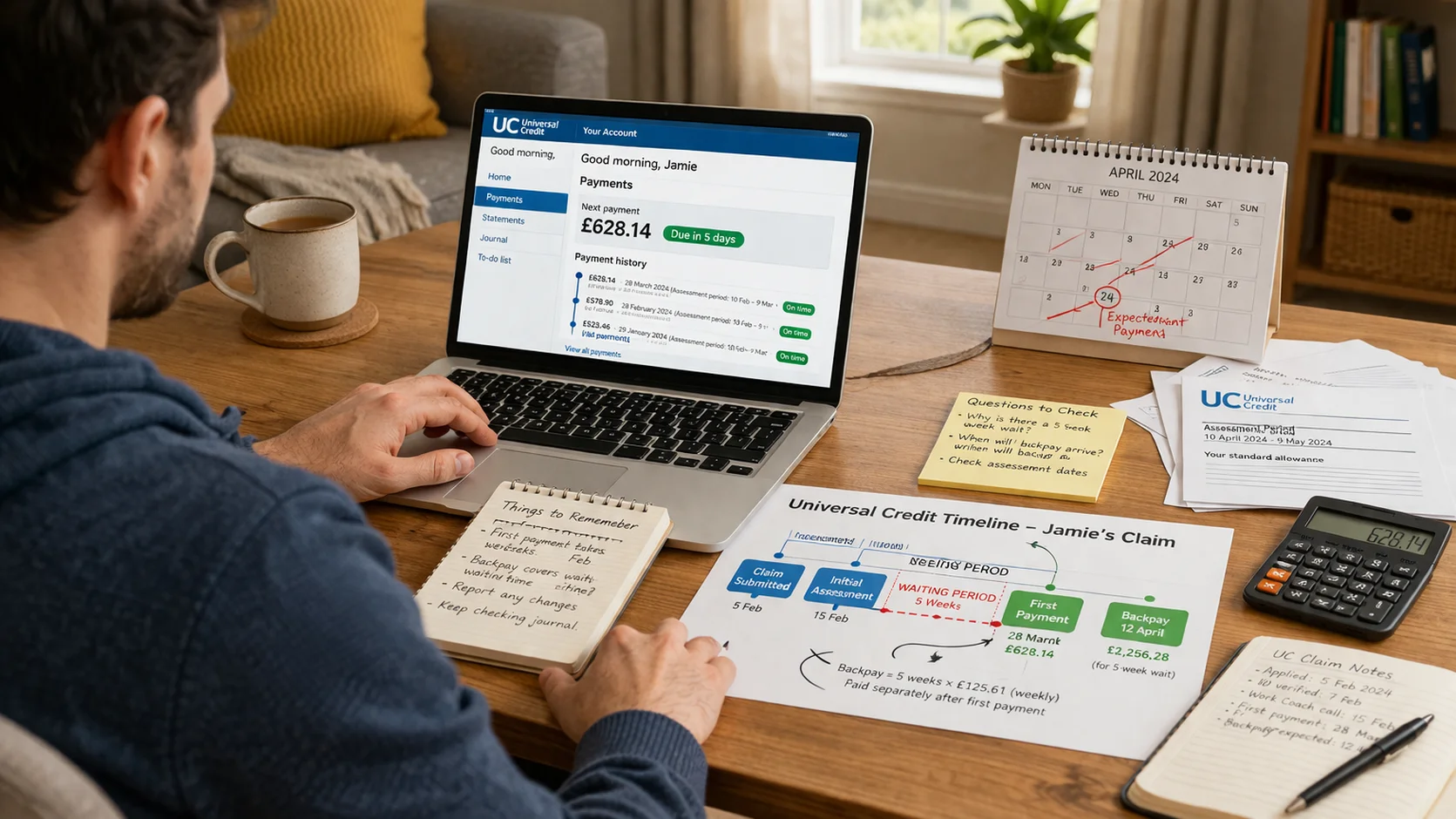
Understanding a real-world timeline can make the process much clearer.
| Event | Example Date |
| Health condition reported | 10 January |
| Assessment Period 1 | 10 Jan to 9 Feb |
| Assessment Period 2 | 10 Feb to 9 Mar |
| Assessment Period 3 | 10 Mar to 9 Apr |
| LCWRA entitlement begins | 10 April |
| First payment issued | Mid May |
This timeline shows that even if the decision is made earlier or later, the payment follows the same structured process.
In practice, this means claimants may experience a delay between approval and payment, but the amount received will reflect their full entitlement.
How Much Is the LCWRA Monthly Payment in the UK?

The LCWRA element is an additional monthly payment included within Universal Credit for those who qualify.
The current rate is approximately £416.19 per month, although this figure is subject to annual updates.
The payment is:
- Added to the standard Universal Credit allowance
- Paid monthly as part of the overall benefit
- Adjusted periodically based on government policy
The financial impact of LCWRA can be significant, particularly for individuals who are unable to work due to long-term health conditions.
What Can Delay Your First LCWRA Payment?
Although the process is structured, there are several factors that can delay the first LCWRA payment.
Common causes of delays include gaps in medical evidence or administrative issues.
| Cause of Delay | Impact |
| Missing fit notes | The waiting period may restart |
| Late reporting of the condition | Delays the start of entitlement |
| Assessment delays | The decision takes longer |
| Incomplete evidence | Further review required |
| Administrative backlog | Payment processing slowed |
These delays can often be avoided by ensuring that all documentation is submitted on time and remains consistent throughout the process.
What Should You Do If Your LCWRA Payment Is Delayed?

If a claimant believes their LCWRA payment is delayed, there are several steps they can take to resolve the issue.
The first step is to review the Universal Credit journal, which provides updates on claims and payments. This can help identify whether the delay is due to processing, missing information, or timing within the assessment period.
Claimants should also check their assessment period dates to confirm when the LCWRA element should have been applied.
If there are concerns, contacting the work coach or case manager through the journal is often the most effective approach.
In some cases, requesting a payment breakdown can provide clarity on how the entitlement has been calculated.
Taking proactive steps can help ensure that any issues are resolved quickly and that payments are received without unnecessary delay.
Key Takeaways About LCWRA First Payment After Decision
The LCWRA first payment after the decision follows a structured process based on assessment periods rather than decision dates. This ensures consistency and accuracy in how payments are calculated.
Understanding the system allows claimants to manage expectations and avoid confusion about when payments will arrive and how much they will receive.
The combination of waiting periods, monthly payment cycles, and backpay calculations forms the foundation of how LCWRA payments are delivered within Universal Credit.
Conclusion
The LCWRA first payment after decision follows a structured process rather than an immediate payout. While it may feel delayed, the system ensures that you receive the correct entitlement, including any backdated amount.
By understanding assessment periods, waiting times, and payment cycles, claimants can better manage expectations and avoid unnecessary confusion.
Frequently Asked Questions
What happens after you are awarded LCWRA?
After being awarded LCWRA, your Universal Credit claim is updated to include the LCWRA element. Payments begin after the waiting period and are added to your monthly entitlement.
Can LCWRA be paid earlier than three months?
In most cases, no. The three-month waiting period is standard unless special circumstances apply, such as terminal illness rules.
How do you know if your LCWRA payment is included?
You can check your Universal Credit statement online. It will show the LCWRA element as part of your monthly breakdown.
Will LCWRA affect other benefits?
LCWRA may impact the total amount of Universal Credit you receive but does not usually reduce other benefits directly.
What if your LCWRA backpay is missing?
You should raise this in your Universal Credit journal and request a breakdown of your payments to ensure arrears have been included.
Do you need to apply separately for LCWRA payment?
No, LCWRA is awarded through the Work Capability Assessment process and is automatically added to your claim if you qualify.
Can LCWRA payments stop once awarded?
Yes, payments can stop if your circumstances change or after a reassessment determines you no longer qualify.