


Table of Contents
Last Checked: 15 July 2026
Royal Mail does not clearly publish a general customer service email address for routine delivery complaints. A customer searching for a Royal Mail complaints email should normally use the official complaints webform, call customer services on 03457 740 740, or write to FREEPOST ROYAL MAIL CUSTOMER SERVICES.
An online complaint may still generate written confirmation and a reference number, even though it is submitted through a webform rather than an ordinary email inbox.
Customers should save that confirmation, together with tracking records, receipts, photographs and previous correspondence.
Key Highlights:
- Use the online complaints form for most customer complaints.
- Visit the Complaints and Claims Hub to find the correct route.
- Call 03457 740 740 for complaint support.
- Send a Freepost letter for formal complaints.
- Use the scam-reporting email only for fraud or phishing reports.
- Escalate eligible unresolved complaints to POSTRS.
Using the correct route from the beginning can reduce duplication and give the investigating team a clearer record of what happened.
Is There an Official Royal Mail Complaints Email Address?
No general complaints email is clearly advertised for personal customers on the official support pages reviewed for this article. Customers are instead directed towards the complaints webform, the Complaints and Claims Hub, telephone support and postal correspondence.
Search results and consumer forums sometimes mention customer.service@royalmail.com. However, an address appearing in a forum thread does not prove that it is a current, monitored or officially supported complaint channel.
Using an unverified address creates several risks. The message may not reach the relevant team, the customer may not receive a complaint reference, and personal information could be shared through an unsuitable channel.
A webform also provides advantages over an ordinary email. It can route the complaint by category, request the information needed for investigation and reduce the risk of a case being sent to the wrong department.
How Can a Customer Make a Complaint to Royal Mail?

A customer should first identify whether the problem concerns service quality, financial compensation or both.
A complaint may address repeated delivery failures, poor communication or inappropriate handling. A claim usually seeks compensation for qualifying loss, damage or delay.
The official online complaints form is the main written route for reporting a general problem. The published support page specifically directs customers who want to complain to a dedicated webform.
Before submitting a complaint:
- Check the tracking history and delivery address.
- Gather the postage receipt and reference number.
- Record the posting date and expected delivery date.
- Save photographs of damage or unsafe delivery.
- Note any earlier conversations or case references.
- Decide what reasonable outcome is being requested.
The customer should then submit one complete complaint and retain the acknowledgement. Sending several incomplete versions through different channels may make the history harder to follow.
Which Royal Mail Complaint Channel Should Be Used?
The correct channel depends on whether the customer wants to report a new problem, discuss an existing case or create a formal written record.
Royal Mail Complaints Form Online
The complaints form is generally the most suitable starting point for delivery and service problems. These may include missing post, repeated late deliveries, incorrect delivery, redelivery failures, employee conduct or poor complaint handling.
The form may ask the customer to choose a category before entering the facts. Selecting the closest relevant category helps route the case to the appropriate operational or customer service team.
Where the issue is specifically about loss, damage or delay compensation, the Claims Centre may be more appropriate. Official guidance says delay compensation may depend on the service used and the delivery date.
When Should the Customer Telephone?
Customers can call 03457 740 740. The same number is listed in current regulatory complaints guidance, alongside an accessibility relay number.
A telephone call may be useful when:
- The correct online category is unclear.
- An existing reference needs to be discussed.
- The tracking information is confusing.
- The customer requires accessibility support.
- Royal Mail has requested further information.
Opening hours can change, so callers should check the current support page before telephoning.
Complaints by post
Customers who prefer to submit a written complaint can contact Royal Mail by post using its official Freepost address.
A formal complaint can be addressed to:
Royal Mail Customer Service Centre
FREEPOST ROYAL MAIL CUSTOMER SERVICES
The address is published without a postcode, and no stamp is normally required when the exact Freepost wording is used.
A postal complaint should include copies rather than irreplaceable original documents. The customer should retain a copy of the letter and consider obtaining evidence showing when it was sent.
What Information Should Be Included in a Royal Mail Complaint?
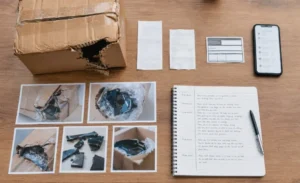
A useful complaint explains what was expected, what happened, what evidence is available and what outcome would resolve the matter.
Evidence checklist:
- Full name, postal address and contact details.
- Sender and recipient information where relevant.
- Tracking, postage or complaint reference.
- Postal product or service purchased.
- Posting date and expected delivery date.
- A short chronological account of events.
- Screenshots of tracking updates.
- Photographs of damaged goods and packaging.
- Proof of postage and proof of value.
- Copies of previous responses.
- The specific resolution being requested.
A complaint letter should be clear, factual and concise, with dates, tracking numbers and reference numbers included where relevant. Clearly state the outcome you want, such as an investigation, explanation, redelivery or compensation where eligible.
End the letter by requesting a written response and details of the next escalation step if the issue remains unresolved.
How Should Missing, Late or Damaged Mail Be Reported?
Missing, delayed and damaged items require different evidence. The person who bought the postage is often better placed to make a claim because that person usually holds the receipt and has the contractual relationship for the service.
How Should Missing Mail Be Reported?
The sender or recipient should first check tracking, the delivery address, any attempted-delivery card and possible safe places. Household members or neighbours may also have accepted the item.
Official guidance states that, for some services, the sender might be able to claim when an item remains undelivered 10 working days after its due date. The exact loss threshold and eligibility should be checked for the particular postal product.
A complaint may also be appropriate where missing mail forms part of a repeated delivery problem rather than a single compensation case.
Reporting a Late Delivery
A late-delivery complaint should identify the service purchased, expected delivery date, actual arrival date and any time-sensitive consequences.
Broader delivery performance remains under regulatory scrutiny. An investigation opened on 1 June 2026 after reported 2025/26 performance showed 75.7% of First Class mail delivered within one working day and 90.2% of Second Class mail within three working days, below the applicable annual targets.
In an earlier official enforcement statement, Director of Enforcement Ian Strawhorne said: “Millions of important letters are arriving late.”
Those national figures provide context but do not determine whether an individual customer is entitled to compensation.
Damaged Items and Packaging
Customers should retain the item, external packaging, internal protection and address label. Photographs should show the condition in which the parcel arrived and the nature of the damage.
Proof of value may also be requested. Packaging should not be discarded until the complaint or claim has been resolved or the investigating team confirms that it is no longer needed.
What Happens After a Royal Mail Complaint Is Submitted?

A customer may receive an acknowledgement and complaint reference. The case can then be reviewed using tracking information, delivery-office records, evidence supplied by the customer and any account of earlier contact.
The current postal complaints guidance confirms that customers should first complain directly to the postal company. It also identifies independent redress as a possible later stage when an eligible complaint remains unresolved.
Typical complaint journey:
| Stage | What may happen | Customer action |
| Submission | The complaint is logged | Save the acknowledgement |
| Investigation | Records and evidence are reviewed | Answer requests for information |
| First response | An explanation or proposed resolution is issued | Check whether every point was addressed |
| Internal escalation | The case receives further review | Identify unresolved points clearly |
| External redress | An eligible dispute may go to POSTRS | Submit the complete case record |
There is no single response time that applies to every complaint. Customers should follow any deadline stated in the acknowledgement and use the escalation instructions included in the response.
How Can an Unresolved Royal Mail Complaint Be Escalated?
Customers should normally complete the company’s formal complaints process before asking an independent dispute-resolution body to consider the case.
Internal Review and the Postal Review Panel
If the first response is unsatisfactory, the customer should explain which questions remain unanswered and provide any evidence that was not previously available.
A customer should retain all responses, especially a final response from the Postal Review Panel. That document may confirm whether the internal process has ended and whether the dispute can be referred externally.
Submitting a clear statement of the unresolved issue is more effective than simply repeating the original complaint.
When Can a Case Go to POSTRS?
POSTRS can consider certain unresolved consumer disputes involving covered postal services. Under the independent redress eligibility rules, a consumer may approach the scheme after receiving a final response from the Postal Review Panel or after 90 calendar days have passed since the company’s complaints procedure began without settlement.
POSTRS only accepts eligible consumer disputes, and applicants must provide supporting evidence. An independent adjudicator reviews the case, and the decision becomes binding on Royal Mail if the consumer accepts it within six weeks.
Business account holders are not covered and should follow Royal Mail’s business complaints process.
What Should Customers Avoid When Searching for a Royal Mail Complaints Email?

The safest approach is to rely on a current official support route rather than the first email address shown in a search result.
Common mistakes to avoid:
- Using an old email address copied from a forum.
- Sending delivery complaints to the scam-reporting inbox.
- Sharing personal data with an unverified address.
- Confusing Royal Mail with Post Office Limited.
- Submitting repeated versions of the same complaint.
- Omitting tracking numbers, dates or evidence.
- Discarding damaged packaging too early.
- Assuming every delay automatically qualifies for compensation.
- Treating live chat as a guaranteed formal complaint channel.
- Sending original documents that cannot be replaced.
Customers searching for a Royal Mail complaints email should therefore use the complaints webform for a written online submission, the published telephone number for support, or the Freepost address for a formal letter.
Conclusion
Customers searching for a Royal Mail complaints email should use the official complaints form, customer service number, or Freepost address rather than relying on unverified addresses found online.
Clear records, tracking details, receipts, photographs, and previous correspondence can strengthen a complaint and support any later escalation.
Where Royal Mail does not resolve an eligible case, the customer may be able to approach POSTRS after completing the required process. Guidance should be checked before submitting information.
Frequently Asked Questions
Is Royal Mail live chat available for every enquiry?
Live chat may appear during some online support journeys, but it should not be assumed to be available for every problem or at every time. A customer who needs a formal complaint record should use the complaints form.
Can the recipient complain when the sender purchased the postage?
The recipient can report a delivery problem, but the sender may need to make the compensation claim because the sender usually purchased the service and holds the proof of postage.
Can screenshots be included with a complaint?
Upload options depend on the form and category selected. Customers should keep tracking screenshots and photographs even when they cannot attach them during the initial submission.
Does a Freepost complaint letter need a stamp?
A stamp is not normally required when the exact published Freepost address is used. Customers should verify the address before sending sensitive or time-critical documents.
Who handles complaints about a Post Office branch?
Royal Mail and Post Office Limited are separate organisations. A complaint about branch staff, branch facilities or a counter transaction should normally be directed to the organisation operating the branch.
Where should a suspicious Royal Mail message be reported?
Suspicious emails can be forwarded to reportascam@royalmail.com. Screenshots of suspicious texts can also be sent there, while suspicious calls or websites should be reported with the telephone number or web address included.
Can a business account holder use POSTRS?
The consumer scheme does not accept complaints from Royal Mail Business account holders. Businesses should follow the relevant business complaints and account escalation process.
Editorial Note:
This independent article is not affiliated with or endorsed by Royal Mail, Post Office Limited, the postal regulator or the independent redress service. Users should always check the latest official guidance before submitting complaints or personal information, as contact details, compensation rules and complaint procedures may change.
How We Checked?
Information was verified against official Royal Mail support pages, regulatory guidance and independent dispute-resolution resources on 15 July 2026. Contact details, complaint routes and claims guidance were cross-checked, while third-party discussions were used only to understand search trends and not as authoritative sources.