
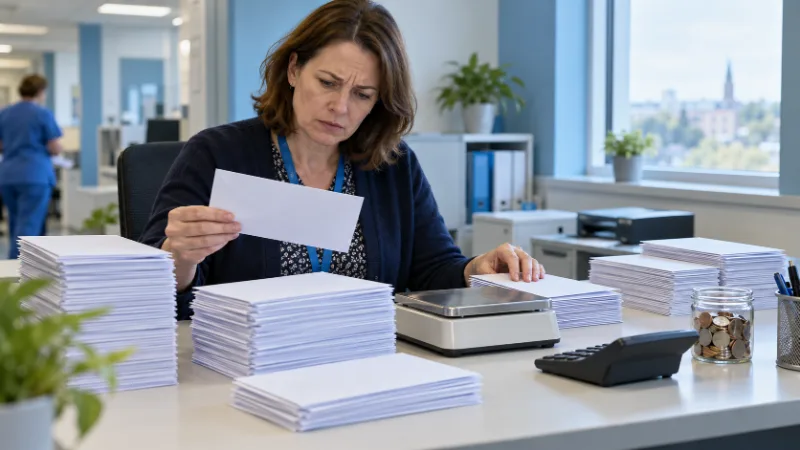
Royal Mail has reportedly scaled back a controversial increase in the cost of delivering millions of NHS letters, bank statements and other bulk mail after postal operators challenged the size of the proposed rise.
The latest development changes the picture considerably for organisations preparing for higher postal costs this autumn.
Royal Mail had originally planned to increase its wholesale access mail prices by an average of around 25% from 5 October 2026, with some individual services facing rises of more than a third.
The changes would have affected postal companies that collect and sort large volumes of correspondence before handing it to Royal Mail for final delivery.
That system is used for huge quantities of business and public-sector mail, including NHS hospital appointment letters, medical correspondence, HMRC communications, bank statements, household bills and marketing mail.
However, following an industry challenge and intervention by communications regulator Ofcom, those October increases were suspended.
New reporting on 25 September says Royal Mail has now offered a lower average increase of around 18%, with the revised pricing expected to take effect in December 2026 rather than October.
The reduction will still leave organisations facing substantially higher mailing costs, but it represents a significant retreat from Royal Mail’s original proposal.
It also means anyone searching for the latest Royal Mail NHS letter pricing needs to distinguish between three different figures: the original 25% average proposal, individual increases that reached roughly 36%, and the newer reported 18% average increase.
The controversy began after Royal Mail notified wholesale customers on 23 July of changes scheduled for 5 October.
One of the most striking proposed increases applied to a bulk business economy letter weighing up to 100g, where the cost was expected to rise by 36.1%. A standard access advertising large letter weighing between 101g and 250g was reportedly facing an increase of 11.4%.
Those figures were considerably higher than the changes consumers normally associate with ordinary stamps.
Royal Mail’s consumer prices are a separate part of its pricing structure. Anyone comparing the two can see how ordinary postage has already changed in 2026 coverage of Royal Mail stamp price increases in 2026.
The wholesale dispute instead concerns what are known as access operators.
Companies including postal and mailing specialists collect correspondence from organisations, sort and process it and then inject it into Royal Mail’s network. Royal Mail remains responsible for the final delivery stage.
Ofcom says Royal Mail is required to provide wholesale access to its postal network and that the associated terms, conditions and charges must be fair and reasonable.
That makes the issue particularly important for organisations sending hundreds of thousands or even millions of letters each year.
Why NHS Letter Costs Became Such A Major Issue?
The NHS emerged as one of the most prominent examples because physical letters remain important for communicating with patients.
Despite the rapid growth of the NHS App, text messages, online patient portals and email, hospitals and other healthcare organisations continue to send appointment information, test-related correspondence and other medical communications through the post.
Previous reporting estimated that the NHS spent at least £100 million on postal letters during 2024.
That does not mean an 18% Royal Mail wholesale increase would automatically add £18 million to the NHS bill.
NHS organisations use different mailing arrangements, products and suppliers, and the headline wholesale increase does not necessarily apply equally to every pound of postal expenditure.
However, even a partial increase across an organisation with postal spending on that scale can translate into millions of pounds of additional pressure.
The importance of physical NHS correspondence was reinforced in Parliament this month.
In a written answer published on 14 September 2026, the Government said it recognised the importance of the timely delivery of NHS letters.
It also noted that Royal Mail had introduced an NHS barcode designed to help NHS units that continue to rely on postal communication with patients.
That creates an awkward situation.
The health service continues to rely on Royal Mail for important communications at the same time that the economics of delivering those letters are becoming increasingly difficult.
Royal Mail argues that the underlying postal network faces structural pressures that cannot simply be ignored.
Letter volumes have fallen dramatically as businesses and consumers move towards digital communication.
Royal Mail previously said access mail volumes had fallen from about 6.3 billion items in 2019-20 to approximately 4.2 billion, a decline of roughly one-third, while the postal network now has around 32 million UK addresses to serve.
Fewer letters therefore have to support the cost of maintaining an enormous nationwide delivery infrastructure.
Royal Mail has also pointed to higher fuel and labour costs and said its finances remain under pressure. The company previously stated that it had accumulated losses of almost £800 million over four years.
The underlying argument is straightforward: even as the number of letters falls, Royal Mail must continue operating a network capable of reaching addresses throughout the country.
But wholesale customers challenged whether the size and timing of the proposed increases were reasonable.
The original October rise also followed another wholesale pricing increase of approximately 9% in January 2026, making the cumulative impact during a single year a major concern for high-volume users.
The Mail Users’ Association, whose membership includes large mailing organisations and financial services companies, described the original increase as “unprecedented” and warned of additional financial pressure on organisations dependent on physical mail.
Postal operators subsequently escalated the issue.
The Mail Competition Forum, acting on behalf of 17 access customers, referred the dispute to Ofcom.
On 4 September, Ofcom formally accepted the case and said it would examine whether the increases announced by Royal Mail represented fair and reasonable wholesale terms.
Crucially, Royal Mail’s contract arrangements meant the disputed increases were suspended while the matter was being considered.
That effectively stopped the planned 5 October 2026 increase from taking effect on its original timetable.
The latest reported compromise goes further.
Royal Mail is now said to be reducing the proposed average rise from roughly 25% to 18%, while moving implementation to December.
The change appears designed to avoid months of uncertainty surrounding the Ofcom process and reduce some of the immediate financial pressure on postal operators and the organisations they serve.
There is, however, an important point of caution.
Reporting on 25 September says the revised proposal resolves the industry dispute, but Ofcom’s publicly available case page was still displaying the matter as open in the latest information available.
Businesses should therefore distinguish between the reported commercial agreement and the regulator’s formal case status until Ofcom updates the record.
For organisations budgeting for large mailing programmes, that distinction matters.
The December increase may be lower than originally proposed, but an average 18% rise would still be significant — particularly for businesses already dealing with higher wages, energy bills, software costs, insurance and other operating expenses.
Businesses looking more broadly at increasing overheads may also find it useful to review where expenditure can be reduced without undermining operations, an issue examined in guide to reducing UK business costs without slowing growth.
There is also a broader pricing trend surrounding Royal Mail.
Consumer stamp prices have risen repeatedly, business products continue to change and declining traditional letter volumes are putting greater pressure on the economics of maintaining the postal network.
Royal Mail’s first-class online letter price currently starts at £1.80, while second class starts at 91p, although those consumer prices should not be confused with the wholesale access rates at the centre of the NHS dispute.
Businesses sending particularly urgent documents also operate under a different pricing structure again. For comparison, there is a separate breakdown of Royal Mail Special Delivery Guaranteed by 1pm prices and delivery rules.
The key distinction is that the NHS controversy is not about someone buying a stamp at a Post Office.
It concerns the infrastructure behind industrial-scale mailings.
That is why an apparently small percentage change can translate into such substantial sums.
An individual sending ten letters may barely notice a modest change in price. A health service, bank, utility supplier or government department sending millions can face a considerably different financial impact.
What Happens To Royal Mail NHS Letter Pricing Now?
For NHS organisations and other large senders, the immediate development is that the original 5 October wholesale price rise will not happen in the form first announced.
The industry challenge successfully delayed those changes, and Royal Mail has reportedly moved towards an 18% average increase from December 2026.
That is lower than the previously planned 25% average increase but remains substantial.
The episode is also likely to accelerate a question already facing large organisations: which communications genuinely need to be sent on paper?
Digital communication is cheaper and quicker in many circumstances, but switching everything online creates its own problems.
Not every patient regularly uses the NHS App. Some people have limited internet access or digital skills. Others may have accessibility requirements or simply rely on written correspondence for important appointments.
Medical communications also carry consequences that ordinary marketing material does not.
A delayed, missed or inaccessible appointment letter can affect patient care.
That means hospitals cannot approach postal savings simply by eliminating paper wherever possible. They must balance cost reduction against reliability, accessibility and patient communication requirements.
The same tension exists elsewhere.
Banks, insurers, government departments and regulated businesses continue to send physical correspondence where customers request it, where digital details are unavailable or where paper remains operationally useful.
As letter volumes continue falling, Royal Mail faces the opposite problem: maintaining nationwide infrastructure while receiving less revenue from traditional correspondence.
That conflict between declining volume and rising unit costs is unlikely to disappear with the December compromise.
The Royal Mail NHS letter pricing row is therefore about more than one increase.
It highlights a much larger challenge facing Britain’s postal system: how to fund a nationwide letter network when fewer organisations and consumers are sending letters, while public services still depend on that network for some of their most important communications.
For the NHS, the reported reduction from 25% to 18% offers some relief compared with the original proposal.
But it does not remove the financial pressure.
If the revised December pricing goes ahead as reported, NHS trusts, mailing contractors, banks and other large organisations will still need to account for significantly higher postal expenditure going into 2027.
And with Royal Mail arguing that declining volumes and rising network costs make higher prices unavoidable, the dispute is unlikely to be the last debate over what Britain should pay to keep physical mail moving.