
Table of Contents
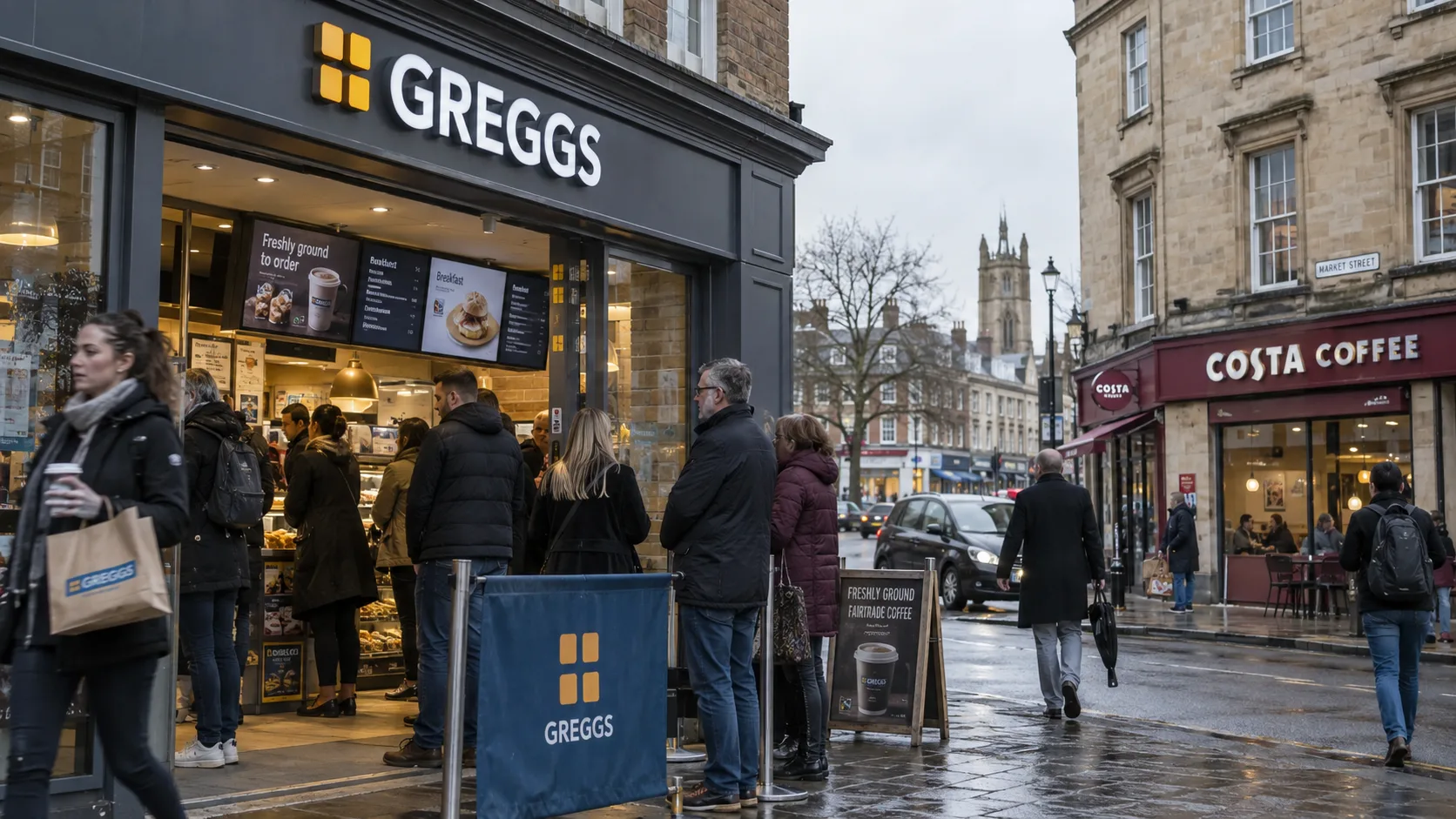
Greggs has overtaken Costa Coffee to become the largest overall operator in the UK branded coffee shop market by outlet count, ending a period of leadership that stretches back almost two decades.
The headline numbers are remarkably close.
Allegra World Coffee Portal’s Project Café UK 2026 recorded 2,737 Greggs outlets compared with 2,707 Costa Coffee locations, putting Greggs ahead by just 30 sites. Starbucks remains third with 1,424 outlets.
Yet the story is bigger than one bakery chain opening more shops than one coffee chain.
Greggs’ rise reflects a significant shift in how Britons buy coffee. The traditional coffee-shop model now competes with bakeries, fast-food restaurants, petrol stations, convenience locations and food-to-go businesses that can serve acceptable coffee quickly and often much more cheaply.
That change fits into the wider movement in UK consumer habits, where convenience, price, digital loyalty and accessibility increasingly influence purchasing decisions alongside the product itself.
There is also an important timing point behind the figures.
Project Café UK 2026 counted 2,737 Greggs locations for its market comparison. Greggs subsequently reported 2,773 shops trading as of 27 June 2026, after opening 34 net new shops during the first half of the year.
The figures therefore come from different reporting dates and should not be treated as contradictory.
A 30-Shop Lead Has Ended Nearly Two Decades of Costa Dominance
The change is historically significant because the last comparable shift at the top of Britain’s branded coffee market happened in 2007.
That year, Costa opened its 555th UK location and moved ahead of Starbucks, which had approximately 540 outlets according to the market data reported at the time.
Costa then remained the dominant UK branded coffee operator for years.
Nearly two decades later, another change has taken place, but this time the challenger is not another conventional coffeehouse business.
It is Greggs.
That makes the 2026 change particularly revealing. The biggest threat to a specialist coffee chain has not come solely from Starbucks, Caffè Nero or an emerging premium café operator. It has come from a food-to-go business that happens to sell a very large amount of coffee.
The shift also reflects some of the broader business trends shaping 2026, particularly the overlap between traditional industry categories as companies compete for the same customer occasions.
How Greggs, Costa and the Other Major Coffee Players Compare?
Outlet numbers provide the easiest comparison, but they tell only part of the story.
| Operator | UK Outlet Position / Footprint | Recent Growth Indicator | Latest Reported Revenue/Sales Figure | Typical Standard Latte Price* | Business Format |
| Greggs | 2,737 in Project Café snapshot; 2,773 reported by Greggs at 27 June 2026 | 34 net shops added in H1 2026 | £1.10bn total sales in H1 2026 | Around £2.25–£2.40 | Food-to-go/bakery with coffee |
| Costa Coffee | 2,707 in Project Café UK 2026 | 36 net stores added in 2025 | Around £1.74bn reported revenue | Around £4.40–£4.50 | Coffee-focused chain |
| Starbucks | 1,424 in Project Café UK 2026 | 1,354 in the previous market report | £556.3m UK FY2025 revenue | Around £4.35 | Coffee-focused chain |
| Caffè Nero | Around 630+ Caffè Nero UK shops | Strong UK expansion across the wider Nero Group | £366m UK sales in FY2025 | Around £3.75 | Premium coffeehouse |
| Pret A Manger | Around 500 UK shops | Expanding further into travel and roadside locations | £1.2bn worldwide sales reported for 2024 | Around £3.50 | Food-to-go and coffee |
*Coffee prices can vary by location, shop format, size, franchise operator and travel-site pricing.
The table also exposes one of the biggest problems with simplistic comparisons between these businesses: their revenue figures do not measure the same thing.
Greggs’ £1.1 billion figure covers total sales for the first half of 2026, including sausage rolls, sandwiches, pastries, drinks, grocery partnerships and other products. It is not coffee revenue.
Costa’s reported revenue covers a different reporting period and business structure.
Starbucks’ £556.3 million figure relates to its UK company for its 2025 financial year, while Caffè Nero’s £366 million relates to the UK operation. Pret’s £1.2 billion figure is worldwide rather than UK-only.
Outlet count, revenue and coffee sales are therefore three different measurements.
Greggs can legitimately be described as Britain’s largest overall branded coffee shop operator by the outlet-count definition used by Project Café UK 2026. That does not automatically mean Greggs sells more coffee than every rival or generates the highest coffee-specific revenue.
Starbucks, Caffè Nero, Pret and McDonald’s Still Matter
Describing the market as a straight Greggs-versus-Costa battle misses much of what is happening.
The entire UK branded coffee shop market reached 12,313 outlets, with market sales estimated at approximately £6.8 billion.
The dataset divides that estate into about 5,784 coffee-focused outlets and 6,529 food-focused outlets.
That second number helps explain why Greggs matters so much.
A growing proportion of coffee competition now comes from businesses where coffee is only one part of the transaction.
Starbucks remains a substantial challenger in third place at 1,424 outlets, although it is still more than 1,300 locations behind Greggs in the Project Café figures.
Caffè Nero remains one of Britain’s most established traditional coffeehouse businesses, while Pret competes across coffee, breakfast and lunch. Pret has also been moving further into travel locations and opened its first UK drive-thru in 2026.
McDonald’s presents another form of competition. McCafé does not need a separate café on every high street because coffee sits inside the wider McDonald’s restaurant network.
In September 2026, McDonald’s was actively promoting McCafé coffee through its app, illustrating how digital promotions can turn an existing fast-food estate into a coffee customer-acquisition network.
The market is therefore not simply dividing between Costa and Greggs. It is increasingly becoming a competition between customer occasions: breakfast, commuting, lunch, shopping, driving and convenience.
Greggs Has Made Coffee Part of a Bigger Value Transaction
Price explains a significant part of Greggs’ appeal, but the underlying business model matters just as much.
A customer entering a specialist coffee shop may principally be there to buy coffee.
A Greggs customer may already be buying a sausage roll, breakfast baguette, sandwich or sweet product. Adding coffee to that transaction increases the overall basket value without requiring Greggs to create a separate café-style customer journey.
This changes the economics.
Traditional coffeehouses frequently operate larger stores with seating areas, more elaborate interiors and locations where property costs can be substantial. They also have staffing and service expectations associated with the coffeehouse experience.
Greggs can operate from smaller units and serve customers rapidly using automated commercial coffee equipment.
The rise of high-capacity bean-to-cup coffee machines has also made it possible for non-specialist operators to provide a consistent coffee product without replicating the traditional barista model in every location.
For a customer, the calculation can be simple.
If a standard latte is roughly £2.25 to £2.40 at Greggs but around £4.40 at Costa, the difference becomes noticeable for someone buying coffee several times each week.
This does not mean all customers will move towards the cheapest operator. Premium cafés continue to grow too.
Instead, the market appears increasingly polarised between consumers seeking clear value and those prepared to pay more for atmosphere, speciality drinks, service or perceived quality.
The most uncomfortable position may be the middle: businesses carrying comparatively high operating costs without offering either the cheapest proposition or a sufficiently distinctive premium experience.
That is why operators across hospitality are increasingly looking for ways to reduce operating costs without slowing growth.
Costa Still Has One Major Advantage on the Road
Greggs may have taken the overall outlet-count lead, but Costa retains considerable strength in one increasingly important format: the drive-thru.
Costa opened its 400th UK drive-thru in March 2026 and announced plans for up to another 40 during the year.
Against Project Café’s 2,707 Costa outlet figure, 400 drive-thrus would equate to roughly 15% of that estate, although the figures come from different reporting points and definitions.
Greggs also operates drive-thrus and has been steadily expanding roadside, petrol forecourt and retail-park locations, but Costa remains much larger in the dedicated coffee drive-thru segment.
The category itself is growing.
Industry data indicated that UK drive-thru coffee locations grew by around 6.7% over the previous year, while close to half of surveyed consumers had used drive-thru coffee.
That matters because convenience is increasingly being fought outside the traditional high street.
Costa can potentially lose the total outlet-count crown while remaining extremely competitive in commuting, roadside and car-based coffee purchases.
Greggs, meanwhile, has been deliberately expanding beyond high streets. In 2025, 64% of its new company-managed shops opened in locations such as supermarkets, petrol forecourts, roadsides and retail parks.
The next stage of the competition may therefore be fought as much beside dual carriageways and supermarkets as it is on town-centre shopping streets.
Coca-Cola and Greggs Are Playing From Very Different Ownership Positions
The two businesses also have fundamentally different ownership structures.
Costa has been owned by The Coca-Cola Company since January 2019, following Coca-Cola’s £3.9 billion acquisition from Whitbread.
That gives Costa access to a global beverage company with distribution, marketing and product-development capabilities far beyond a conventional UK café chain.
Its business also extends beyond physical coffeehouses through Costa Express machines, packaged coffee and other formats.
Greggs is different.
It remains a publicly listed UK company and is a constituent of the FTSE 250, meaning its strategy is directly visible through shareholder reporting and financial-market scrutiny.
Greggs is investing heavily in logistics capacity to support its physical expansion. New distribution centres in Derby and Kettering are intended to help create infrastructure capable of supplying at least 3,500 UK shops over the longer term.
The ownership difference does not automatically make one model stronger than the other. It does, however, influence how the companies can deploy capital, develop new formats and pursue expansion.
Costa sits inside a multinational drinks business. Greggs is building its growth strategy around the economics of its own food-to-go network.
What the Change Means for Coffee Drinkers?
For consumers, Greggs overtaking Costa is unlikely to transform their coffee routine overnight.
Costa remains highly visible and was named the Nation’s Favourite Coffee Shop for the 16th consecutive year in a 2026 consumer survey. Being overtaken in outlet numbers is therefore not the same as suddenly losing customer loyalty.
What has changed is choice.
A commuter who once viewed Costa, Starbucks and Caffè Nero as the obvious branded coffee options can now find increasingly credible alternatives in Greggs, McDonald’s, Pret, petrol stations and convenience locations.
Price differences are also becoming harder to ignore.
Someone buying five £2.25 coffees a week spends roughly £11.25 before rewards or promotions. At £4.40 per drink, the same frequency costs £22.
Over a working year, that gap can become substantial.
But price is only one part of the decision. Customers may still choose Costa, Starbucks or Nero for seating, barista service, drink customisation, meeting space or the overall coffeehouse environment.
Greggs’ success does not prove Britain has stopped caring about premium coffee.
It suggests consumers increasingly expect both value and convenience to compete with premium experience.
How Was the Coffee Market Data Compiled?

The outlet figures originate from Allegra World Coffee Portal’s Project Café UK 2026, an annual industry study rather than a simple count taken from company websites.
The 364-page research covers more than 250 individual branded operators, alongside historical outlet data, market sizing, pricing comparisons, drive-thru analysis and operator profiles.
Its research programme also incorporates more than 100 industry surveys, consultations and interviews, while its consumer analysis is based on more than 30,000 UK coffee-shop consumer surveys.
That methodology matters because an “outlet” can be counted differently from the number a company publishes in a trading statement.
Franchise sites, concessions, travel-hub stores, kiosks and different reporting dates can all create apparent discrepancies.
Costa, for example, has separately referred to operating more than 2,800 UK stores, while Project Café’s comparable market ranking used 2,707. Greggs’ company-reported June estate of 2,773 is likewise later than the 2,737 figure used in the market snapshot.
For comparisons between operators, figures produced on the same methodology and reporting basis are therefore more useful than mixing independently reported company totals.
Greggs’ Lead Could Become Much Wider — but It Is Not Guaranteed
The present gap is only 30 outlets, so calling the competition settled would be premature.
Greggs expects approximately 100 to 110 net shop openings during 2026 and says it sees an opportunity for at least 3,500 UK locations over the longer term.
Costa is not standing still. It continues to open new stores, expand drive-thrus and refurbish existing high-street, shopping-centre and retail-park locations.
A simple illustration shows why future opening rates matter.
Project Café’s previous figures placed Greggs at 2,610 outlets and Costa at 2,671. The 2026 report moved those totals to 2,737 and 2,707 respectively.
That represents an increase of about 127 outlets for Greggs versus 36 for Costa on those comparable snapshots.
If that difference in net additions were repeated, Greggs’ 30-site advantage could widen quickly. But that is an illustration rather than a forecast. Openings, closures, franchise decisions, property availability and changes in market methodology can all alter the outcome.
What is clearer is the strategic direction.
Greggs is no longer merely a bakery that happens to sell coffee.
Costa is no longer competing only against traditional coffee chains.
The significance of Greggs overtaking Costa in the UK is that the boundary separating coffee shops, bakeries, fast food and convenience retail has become increasingly difficult to see.
The last change at the top came in 2007, when Costa overtook Starbucks.
Almost two decades later, Greggs has taken the lead — and this time the new market leader has arrived from outside the traditional coffeehouse category.