

Table of Contents
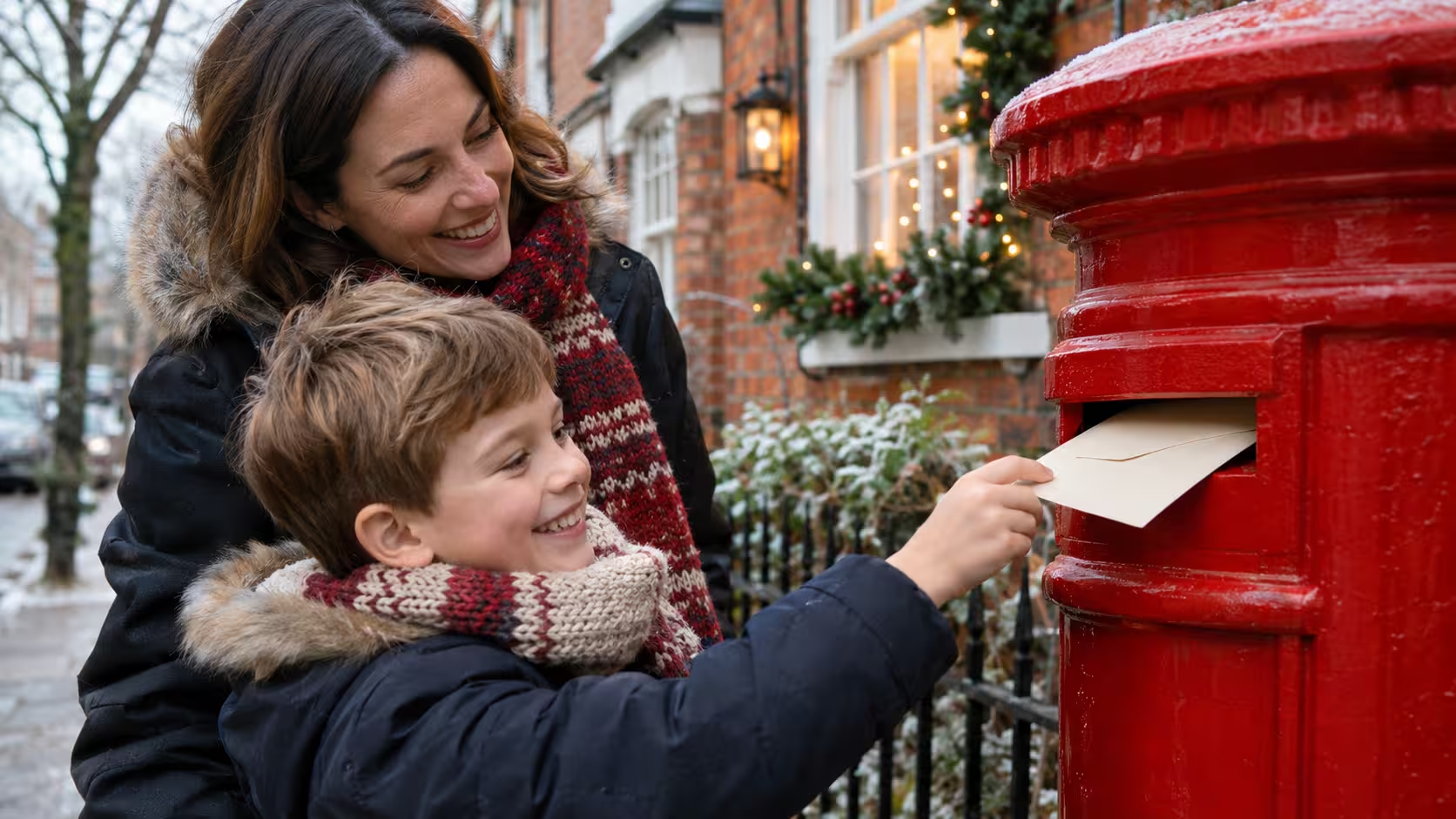
Christmas is approaching, and the Royal Mail Letter to Santa service is returning to help children across the UK send their festive wishes directly to Father Christmas.
The annual tradition offers families an opportunity to create special memories while highlighting how an established postal business can build lasting relationships with customers through seasonal engagement.
For 2026, Royal Mail has confirmed that children should post their letters by Wednesday, 9 December 2026, to give Santa and his helpers time to prepare replies before Christmas.
The service has become an important part of the festive season, combining traditional letter writing with customer engagement, operational planning and accessible communication.
For parents, the priority is understanding the correct Santa address, postage requirements and deadlines. For businesses, schools and community organisations, the programme also demonstrates how a simple seasonal service can create meaningful experiences without relying on expensive technology or commercial promotions.
What Is the Royal Mail Letter to Santa Service?
The Royal Mail Letter to Santa programme is a Christmas initiative that allows children to send letters and wish lists to Father Christmas using a dedicated postal address.
Royal Mail has supported this festive tradition for more than 60 years, helping children experience the excitement of sending a personal letter and potentially receiving a response.
Unlike commercial services selling personalised Christmas letters, Royal Mail does not charge families for Santa’s reply. However, the original letter must carry the correct postage.
The programme operates during the busy Christmas mailing period, when Royal Mail is also handling seasonal cards, gifts, business correspondence and online shopping deliveries.
From a business perspective, the initiative illustrates the importance of maintaining familiar customer traditions. Although postal communication has increasingly moved towards digital channels, physical letters can still create personal experiences that are difficult to reproduce through automated messages.
The scheme also gives children an opportunity to practise handwriting, express gratitude and understand how postal communication works.
What Is the Royal Mail Letter to Santa Address in 2026?
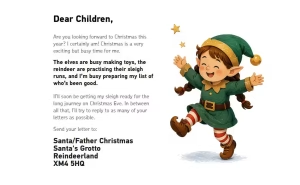
Children sending their Christmas letters through Royal Mail should use the following address:
Santa/Father Christmas
Santa’s Grotto
Reindeerland
XM4 5HQ
This is Royal Mail’s published postal address for Santa letters.
Parents should ensure the address is written clearly on the front of the envelope, including the postcode XM4 5HQ.
The postcode is especially important because it identifies the dedicated Santa mailing destination within the postal system.
How Should You Address the Envelope?
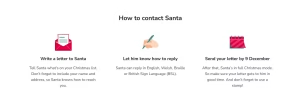
The front of the envelope should contain Santa’s complete address, while the child’s full name and return address should appear on the back.
A correctly prepared envelope should include:
- Santa’s name and complete postal address on the front.
- The postcode XM4 5HQ.
- An appropriate Royal Mail postage stamp.
- The child’s full name on the back.
- The child’s complete return address, including postcode.
- Clear handwriting that postal workers can easily read.
Royal Mail specifically asks families to include the child’s name and address on the back of the envelope so a reply can be sent.
Parents should check the details before posting because missing or inaccurate address information can prevent a response from reaching the correct household.
When Is the Royal Mail Letter to Santa Deadline in 2026?
Royal Mail has confirmed Wednesday, 9 December 2026, as the deadline for families sending letters to Santa.
The deadline provides time for Royal Mail to process incoming letters and help Santa prepare responses during the Christmas period.
However, an important distinction applies to schools and organised groups, which have an earlier deadline.
| Letter category | Official deadline | Important requirement |
| Individual children’s letters | Wednesday, 9 December 2026 | Stamp and return address required |
| Letters sent through schools | Wednesday, 2 December 2026 | Follow the school and group mailing instructions |
| Letters requesting Welsh replies | Wednesday, 9 December 2026 | Use the Welsh-language address |
| Braille or large-print replies | Arrange as early as possible | Contact Royal Mail by email |
| British Sign Language replies | Arrange as early as possible | Email Royal Mail to request the format |
The deadline for schools is particularly important because teachers often organise group activities involving several children.
Families are advised to send letters before the final date rather than waiting until 9 December.
Posting early reduces the likelihood of delays caused by heavy seasonal demand, missed postbox collections or incomplete address details.
The Santa letter deadline should not be confused with the standard Royal Mail Christmas posting dates for cards, parcels and business deliveries.
Those dates apply to different postal services and are generally later than the special Santa programme deadline.
For businesses planning Christmas promotions, this distinction highlights why specific service deadlines should be communicated separately rather than relying on a single general Christmas posting calendar.
How Can Children Write and Send a Letter to Santa Through Royal Mail?
Writing a letter to Santa does not require a complicated template or special stationery.
Children can use ordinary writing paper, decorated Christmas cards or printable letter templates.
The important consideration is ensuring that the letter is easy to read and contains information Santa can use when preparing a reply.
Writing the Christmas Letter
A simple letter can begin with a greeting, followed by the child’s name, age and Christmas wishes.
Children might also describe something they enjoyed during the year, an achievement they are proud of or something kind they have done.
Encouraging children to include personal experiences makes the activity more meaningful than simply preparing a shopping list.
For younger children, parents can help write the letter or allow them to draw pictures.
Example of a Letter to Santa
Dear Santa,
My name is Oliver, and I am seven years old.
I am very excited about Christmas this year. I have been working hard at school, helping my parents and trying to be kind to my friends.
For Christmas, I would love a football, a new storybook and a building set.
I hope you, Mrs Claus, the elves and all the reindeer are doing well.
Thank you for making Christmas special for children everywhere.
Merry Christmas!
Love,
Oliver
This example keeps the language simple and gives children enough flexibility to express their own wishes.
Once the letter is complete, a parent should check the envelope, attach the correct postage and arrange for it to be posted.
How Much Does It Cost to Send a Royal Mail Letter to Santa?
The Royal Mail Letter to Santa service does not charge for Santa’s reply, but families must pay the postage cost for sending their letters.
The amount depends on the postage class and the size and weight of the envelope.
Royal Mail’s published standard letter stamp prices in November 2026 are:
| Postage option | Published price | Standard letter weight limit |
| Royal Mail 1st Class | £1.80 | Up to 100g |
| Royal Mail 2nd Class | £0.91 | Up to 100g |
| Santa’s reply | No separate charge | Subject to the programme’s reply arrangements |
A standard letter must also fit Royal Mail’s size requirements. Larger, thicker or heavier envelopes may require additional postage.
For a typical handwritten Santa letter, an appropriately sized standard envelope with a 1st or 2nd Class stamp is usually sufficient.
Royal Mail aims to deliver 1st Class post by the next working day and 2nd Class post within three working days, although these are not guaranteed delivery times.
Families posting close to the Santa deadline should allow sufficient time for collection and delivery.
Do children need to include a stamped return envelope?
Royal Mail does not instruct families to include a separate stamped return envelope. Its published instructions require postage on the original letter and the child’s full return address on the back.
This distinction is useful for parents who may confuse the Royal Mail scheme with other personalised Christmas letter services that charge additional fees.
Will Royal Mail Send Every Child a Reply From Santa?
Royal Mail aims to help Santa respond to as many children as possible, but it does not guarantee that every letter will receive a reply.
The official programme makes this clear because the number of letters received during the festive season can be substantial.
A letter posted before the deadline with the correct postage and return address has followed the published participation requirements, but this does not guarantee a response.
Jennifer Robb, identified as Royal Mail’s chief elf in a November 2026 report, emphasised the practical requirements for participating:
“Remember to add a stamp and include your full name and address so Santa knows where to send his reply.”
Her advice reflects one of the central operational requirements of the programme: successful return delivery depends on accurate information supplied by the sender.
Royal Mail’s arrangements also demonstrate how customer expectations influence service quality.
For any organisation, communicating a realistic service commitment is preferable to promising an outcome that depends on seasonal demand and postal operations.
Parents should therefore explain that Santa receives many letters and may not be able to answer every child personally.
How Long Does a Reply From Santa Take?
Royal Mail does not publish a guaranteed delivery date for individual Santa replies.
The timing can vary depending on when the original letter was posted, the volume of correspondence and postal delivery conditions.
If a reply has not arrived, families should avoid assuming that the original letter was lost.
Ordinary stamped letters generally do not provide the same tracking visibility as dedicated tracked parcel services.
A delayed Santa response is therefore different from a commercial parcel where the recipient has a tracking number.
Can Children Receive Royal Mail Santa Letters in Welsh, Braille or BSL?
Royal Mail provides alternative communication arrangements to make the Christmas letter experience more accessible.
Children who would prefer a reply in Welsh can send their letter using the Welsh-language address.
Siôn Corn
Ogof Siôn Corn
Gwlad Y Ceirw
XM4 5HQ
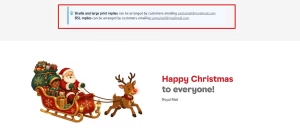
The official instructions also explain that Braille, large-print and British Sign Language replies can be arranged.
For these formats, families should contact:
Parents should explain which accessible format is required and provide the relevant delivery details securely through Royal Mail’s designated contact channel.
These arrangements are particularly significant from a business accessibility perspective.
A customer experience should not depend entirely on a person’s ability to read standard printed correspondence.
For organisations providing public-facing services, accommodating different communication requirements can improve participation and reduce unnecessary barriers.
Royal Mail’s approach illustrates how an established service can adapt a traditional activity to meet different accessibility needs.
How Can Schools and Community Organisations Participate in the Santa Letter Programme?
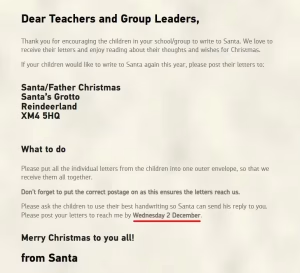
Royal Mail provides separate instructions for schools and organised groups participating in its Letters to Santa programme.
For 2026, schools and groups are asked to send their letters by Wednesday, 2 December.
This is earlier than the deadline for individual families.
The published instructions require teachers and group leaders to place children’s individual letters together inside one outer envelope and apply the correct postage.
The group envelope should be addressed to Santa’s Grotto using the official Reindeerland postcode.
Because the outer envelope may contain numerous letters, its postage requirement should be checked against the total size and weight rather than assuming that one standard letter stamp will be sufficient.
Teachers should also use clear handwriting and follow the programme’s arrangements for replies.
If a school has not received its expected replies, Royal Mail directs it to contact santamail@royalmail.com.
Planning a School Letter-Writing Activity
Schools can incorporate the programme into literacy activities, art sessions or seasonal classroom projects.
Children can practise letter structure, greetings, handwriting and written communication.
A classroom may also use the activity to introduce basic postal concepts such as addresses, postcodes, delivery services and the purpose of postage stamps.
For example, a primary school could arrange a letter-writing session during the final week of November, collect completed letters and prepare the group envelope ahead of the 2 December deadline.
Local businesses may support these activities by supplying paper, envelopes or other classroom materials.
However, participation should remain child-focused, and organisations should avoid using children’s letters or personal addresses for unrelated marketing activities.
Why Is the Royal Mail Letter to Santa Campaign Relevant to UK Businesses?
The Royal Mail Letter to Santa initiative provides an example of how businesses can maintain customer engagement through traditions that create an emotional connection with their services.
For a postal operator, the campaign is not simply about delivering letters. It also reinforces the role of physical communication in family life.
Building Brand Recognition Through Tradition
Royal Mail has been associated with children’s Christmas correspondence for more than six decades.
This continuity gives the programme a recognisable place in the annual festive calendar.
From a marketing perspective, recurring seasonal campaigns can help businesses establish familiarity because customers know what to expect and when to participate.
A small business could apply a similar principle through annual community events, seasonal thank-you cards or educational activities.
However, an effective campaign should provide genuine value rather than presenting every festive interaction as an opportunity to sell products.
Managing High Seasonal Demand
The Santa programme also demonstrates the operational challenges involved in handling seasonal correspondence.
Royal Mail employee Mark Dawson, speaking about the programme in December 2025, described the work of gathering children’s letters, opening and preparing them as part of the Christmas operation.
His account provides a practical insight into the processes behind an apparently simple customer-facing service.
For businesses, this highlights the importance of preparation.
A successful Christmas campaign requires appropriate staffing, reliable processes, sufficient supplies and clearly communicated deadlines.
These principles are equally relevant to retailers preparing promotional orders and organisations sending large volumes of seasonal correspondence.
Supporting Customer Trust Through Clear Information
One of the strongest features of the Santa programme is its straightforward set of participation requirements.
Royal Mail communicates the destination address, deadline, postage requirement and return-address instructions.
Businesses can apply the same principle to commercial deliveries.
Customers benefit when organisations clearly explain dispatch dates, delivery expectations, possible delays and the information required to resolve a problem.
For example, an online retailer should distinguish between a parcel awaiting its first tracking scan and an order that has failed to reach the delivery network.
Our examination of common reasons Royal Mail tracking may not work highlights why businesses should identify the underlying issue before communicating an estimated resolution to customers.
The broader principle is that reliable communication forms part of the customer experience, even when the business cannot control every stage of delivery.
What Can Small Businesses Learn From Royal Mail’s Christmas Letter Campaign?
The success of any seasonal engagement initiative should be judged by the experience it creates and the organisation’s ability to deliver what it promises.
A small business does not need the resources of a national postal operator to introduce a meaningful Christmas activity.
Independent retailers could organise festive card-writing sessions, while community businesses might sponsor school stationery or support local Christmas events.
The important consideration is ensuring that these activities are relevant to the audience and managed responsibly.
| Business principle | Royal Mail example | Practical application for small businesses |
| Seasonal engagement | Annual Santa correspondence | Run a consistent Christmas community activity |
| Customer communication | Clearly published posting deadlines | Publish accurate order and dispatch cut-offs |
| Personalisation | Replies addressed to individual children | Personalise appropriate customer thank-you messages |
| Accessibility | Alternative reply formats | Offer suitable communication options |
| Operational planning | Dedicated seasonal letter handling | Prepare staffing and processes for peak demand |
| Trust and transparency | Replies are not guaranteed | Avoid making delivery promises that cannot be supported |
A particularly useful lesson concerns customer information.
The Santa programme relies on children providing their postal addresses for a specific purpose.
Businesses organising their own family activities should collect only the personal information necessary, explain how it will be used and ensure that children’s details are handled appropriately.
It is also important not to imply that an independent promotional activity is officially endorsed by Royal Mail.
What Mistakes Should Families Avoid When Sending Letters to Santa?
Although Royal Mail has simplified the participation process, avoidable mistakes can still affect delivery or the likelihood of receiving a response.
One common problem is omitting the return address.
Parents sometimes concentrate on writing the correct Santa address but forget that Royal Mail also needs the child’s complete name and home address.
Another issue is applying insufficient postage, particularly when children decorate envelopes using thick cards or bulky materials.
Large decorations may change the envelope’s thickness or postal category.
Families should also avoid relying on outdated Christmas information found in previous years’ articles.
The programme deadline can change annually, making current official instructions more reliable than old social media posts or previously published guides.
Finally, parents should remember that the Santa programme is not a parcel delivery or gift fulfilment service.
Children are invited to send their wishes and may receive a reply, but the scheme does not promise that requested presents will be supplied.
What Should Parents Do If They Miss the Royal Mail Santa Letter Deadline?
Families who miss the 9 December deadline can still enjoy the experience of writing a Christmas letter, but they should not assume that Royal Mail will be able to arrange a reply before Christmas.
The published deadline exists to allow enough time for the Christmas mailing process.
If the deadline has passed, parents can preserve the family tradition by keeping the child’s letter as a Christmas memory or creating a personalised response at home.
A homemade reply can acknowledge the child’s achievements and encourage kindness and gratitude.
Parents should avoid presenting an unofficial reply as a guaranteed Royal Mail service.
For schools, missing the earlier 2 December deadline may also make it difficult to coordinate responses before the end of term.
The best approach is to plan the activity in advance and confirm the latest official arrangements before posting.
FAQs About Royal Mail Letter to Santa
Is the Royal Mail Letter to Santa Service Free?
Royal Mail does not charge separately for Santa’s reply, but families must pay the postage cost to send their original letter.
What Is the Postcode for Royal Mail Santa Letters?
The postcode is XM4 5HQ. It should be included with Santa’s Grotto, Reindeerland, on the front of the envelope.
Can I Send a Letter to Santa Using a 2nd Class Stamp?
Yes. A correctly priced 2nd Class stamp can be used for a qualifying standard letter. Post early enough to allow for delivery.
Does Royal Mail Guarantee a Reply Before Christmas?
No. Royal Mail says Santa will try to answer as many letters as possible, but individual replies and delivery dates are not guaranteed.
Can Schools Send Multiple Santa Letters Together?
Yes. Royal Mail instructs schools and groups to place children’s individual letters inside one outer envelope with the correct postage.
Can my child receive a letter from Santa in British Sign Language?
Yes. Families can request a BSL reply by emailing santamail@royalmail.com. Braille and large-print options can also be arranged.
Can Children Send Letters to Santa After 9 December?
The official deadline for individual letters is 9 December 2026. Posting after this date may reduce the chance of receiving a reply before Christmas.