

Table of Contents
Royal Mail customers in parts of the UK may notice something different on their streets during August 2026.
The postal operator has started deploying its first electric cargo cycles, with the initial vehicles appearing in cities including London, Brighton and Cambridge.
The Royal Mail August delivery changes are primarily an operational change rather than a nationwide alteration to delivery days, postage services or customer eligibility.
Royal Mail says the new vehicles are intended to make urban delivery rounds more efficient while reducing emissions and improving local air quality.
The first deployment consists of 20 Minimal Pedal 4 electric cargo cycles, with Royal Mail indicating that additional locations could follow in the future.
What Exactly Is Royal Mail Changing in August?
The most visible change is the introduction of an entirely new type of Royal Mail delivery vehicle.
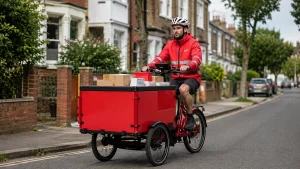
Rather than every delivery round relying on a conventional red van, some postal workers in participating urban areas will be able to use an electrically assisted cargo cycle.
Royal Mail announced that its first 20 Minimal Pedal 4 cycles would be deployed during the month in locations including London, Brighton and Cambridge.
According to Royal Mail, giving individual postal workers access to a dedicated vehicle rather than having some staff share vans could help streamline routes and potentially make deliveries more efficient.
The announcement was also reported by the Mirror, which highlighted the August launch and Royal Mail’s wider move towards lower-emission deliveries.
Is Royal Mail Replacing All Vans With Cargo Cycles?
No.
The August launch involves only 20 cargo cycles initially, and Royal Mail has not announced that conventional delivery vans are being removed nationwide.
The vehicles are better understood as another option within Royal Mail’s increasingly mixed delivery fleet.
Depending on the location and type of route, deliveries may continue to involve:
- postal workers travelling on foot;
- conventional vans;
- electric vans;
- smaller electric vehicles; or
- the new electric cargo cycles.
Royal Mail says just over half of its delivery routes are already wholly or partly completed on foot, while around 31% of routes are classified as zero-emission.
Where Are Royal Mail’s New Electric Cargo Cycles Being Used?
Royal Mail has specifically named cities including:
- London
- Brighton
- Cambridge
The wording is important. Royal Mail has said the vehicles are being introduced in cities including those locations, rather than presenting the three cities as a permanent or exhaustive national list.
Further deployment is planned, but customers should not assume that every UK delivery office will receive the cycles during August.
Royal Mail’s announcement says the first 20 vehicles are being introduced before a potential broader rollout.
What Is a Minimal Pedal 4?
Despite looking closer to a compact delivery vehicle than a traditional bicycle, the Minimal Pedal 4 is designed as an electrically assisted cargo cycle.
Minimal describes it as a four-wheel e-quadricycle developed for urban logistics.
The vehicle has:
- pedal assistance;
- two 250W continuous-rated rear motors;
- an assisted maximum speed of 15.5mph;
- swappable batteries;
- up to 60km of stated range with two batteries;
- a 2.5m³ cargo compartment; and
- capacity for a substantial delivery load.
The manufacturer says the vehicle has been developed for environments where full-sized vans may be less convenient, particularly congested city streets and last-mile delivery routes.
How Far Can The New Royal Mail Cargo Cycles Travel?
Royal Mail has publicised a range of up to approximately 37 miles on a charge configuration, while Minimal’s current technical specification states up to 60km, which is roughly 37 miles, when two batteries are used.
Actual operating range can naturally vary according to conditions such as vehicle load, route, battery configuration, gradients and usage.
That means the quoted figure should be treated as a vehicle specification rather than a guarantee that every Royal Mail delivery round will cover exactly 37 miles.
Do Royal Mail Workers Need a Driving Licence for the New Cycles?
A normal driving licence is not required to ride a vehicle that legally qualifies as an electrically assisted pedal cycle, or EAPC.
GOV.UK states that qualifying EAPCs do not require a driving licence, registration, vehicle tax or compulsory motor insurance.
To satisfy the standard EAPC rules in Great Britain, a cycle must have usable pedals, its continuous-rated electric motor power must meet the relevant limit, and electrical assistance must cut out by 15.5mph.
Importantly, an EAPC can have more than two wheels.
This distinction may help Royal Mail recruit people for suitable delivery roles who can cycle and meet the company’s employment and training requirements but do not hold a car driving licence.
It does not mean that the vehicles can be operated without training or normal workplace safety procedures.
Minimal’s own guidance states that the Pedal 4 should be used by trained and authorised personnel.
Can the Royal Mail Cargo Cycles Use Cycle Lanes?
A compliant EAPC can generally be used where ordinary pedal cycles are permitted.
GOV.UK says EAPCs can be ridden on cycle paths and elsewhere pedal bicycles are allowed, but not on pavements.
Minimal also describes the Pedal 4 as being designed for urban roads, cycle infrastructure and last-mile environments.
Customers may therefore see the distinctive four-wheeled vehicles in places where a conventional Royal Mail van would be less practical.
Will the August Changes Make Royal Mail Deliveries Faster?
Royal Mail believes the new vehicles can make suitable delivery rounds more efficient, but customers should be cautious about interpreting that as a new delivery-time guarantee.
The company says individual cargo cycles can reduce the need for some postal workers to share vans, helping streamline routes and potentially speed up the delivery process.
However, Royal Mail has not announced a new nationwide delivery-speed commitment as part of the cargo-cycle rollout.
A customer’s actual delivery time can still depend on factors such as:
- the postage service purchased;
- the local delivery office;
- mail volumes;
- staffing;
- weather;
- transport-network disruption; and
- the particular delivery route.
Practical Example
A customer in Cambridge who normally sees a Royal Mail van may instead see a postal worker arriving in a four-wheeled electric cargo cycle during August.
That does not automatically change a Tracked 24 parcel into a faster service or change the contractual terms of the postage purchased.
The principal difference is the vehicle being used for the final part of the delivery journey.
Why Is Royal Mail Introducing Electric Cargo Cycles?
 The move forms part of a much broader effort to decarbonise Royal Mail’s delivery network.
Royal Mail says it operates the UK’s largest electric van delivery fleet and currently has almost 9,000 electric vans It also states that 31% of its delivery routes are now zero-emission.
Its longer-term target is to reach Net-Zero by 2040.
The company is therefore pursuing several approaches rather than relying exclusively on one type of electric vehicle. These include electric vans, micro-electric vehicles, walking routes and now electric cargo cycles.
Royal Mail has said that the cargo cycles should help reduce carbon emissions and improve air quality in the communities in which they operate.
Are Normal Royal Mail Delivery Days Changing in August?
The electric cargo-cycle rollout itself does not represent a nationwide reduction or change in Royal Mail’s normal delivery days.
Royal Mail says it normally delivers letters and small parcels from Monday to Saturday, although individual services and local circumstances can vary.
There is, however, a separate date customers should be aware of towards the end of August.
What Happens on the August 2026 Bank Holiday?
Monday 31 August 2026 is the Summer Bank Holiday.
Royal Mail’s official service calendar currently states that there will be no collections or deliveries in England and Wales on 31 August, and no normal service in Northern Ireland.
Scotland has different local arrangements. Royal Mail lists several Scottish postcode areas where services will continue on 31 August, while other areas will have no collections or deliveries.
Customers expecting an important letter or parcel around the bank-holiday weekend should therefore check Royal Mail’s live service information rather than relying solely on normal weekday estimates.
Are There Other Royal Mail Changes From 3 August 2026?
 Yes, but several of them relate primarily to business customers rather than ordinary household deliveries.
Royal Mail’s official terms and pricing information lists a number of changes taking effect from 3 August 2026.
Business Parcelshop Surcharge
A notable change affects certain Royal Mail business-account customers.
From 3 August, Royal Mail says a £10 surcharge plus a £1.25 administration charge can apply to each Business Account Tracked item incorrectly presented at a consumer Parcelshop when the customer’s agreement already includes free collections.
This should not be confused with a general £11.25 charge for members of the public sending parcels.
It applies to the specified business-account circumstances.
Other Business Changes
Royal Mail’s published August changes also include:
- withdrawal of the Advertising Mail Catalogue letter and large-letter product;
- revised Timed Delivery renewal, cancellation and refund wording;
- new peak-period capacity arrangements for certain business collections; and
- an increase in Business Keepsafe up to 100 days to £121.
These changes are separate from the electric cargo-cycle rollout.
What Do Customers Need to Do?
For most households, nothing is required because of the new cargo cycles.
Customers can continue to address, post, track and receive Royal Mail items in the normal way.
Those living in one of the initial rollout cities may simply notice a different vehicle completing local delivery rounds.
Customers who are waiting for an important item should continue to use Royal Mail’s official tracking and service-update tools rather than attempting to predict delivery times based on whether a van or cargo cycle is operating locally.
Final Takeaway
The Royal Mail August delivery changes are most noticeable as a change to how some letters and parcels are transported rather than a fundamental change to when Royal Mail delivers.
The first 20 Minimal Pedal 4 electric cargo cycles are being introduced during August 2026 in cities including London, Brighton and Cambridge. Royal Mail hopes the vehicles will make appropriate urban rounds more efficient, reduce emissions and improve local air quality.
For most customers, there is no new action to take and no change to the postage service they have purchased simply because a cargo cycle completes the final delivery.
There are, however, separate August developments worth knowing about. Certain Royal Mail business terms changed from 3 August 2026, while the 31 August Summer Bank Holiday will affect collections and deliveries across much of the UK.
Customers should therefore distinguish between Royal Mail’s new delivery vehicles, separate business-account changes and bank-holiday service arrangements when checking reports about Royal Mail changes this August.
Frequently Asked Questions
What are the Royal Mail August delivery changes?
Royal Mail is rolling out its first 20 Minimal Pedal 4 electric cargo cycles during August 2026 in cities including London, Brighton and Cambridge. The vehicles will support suitable urban delivery rounds.
Which UK cities are getting Royal Mail electric cargo cycles?
Royal Mail has specifically named London, Brighton and Cambridge among the initial locations. Further locations are expected to follow, although a complete future rollout list has not yet been announced.
Will Royal Mail deliveries be faster in August 2026?
Royal Mail says the new cargo cycles may help streamline delivery rounds and improve efficiency. However, no universal faster-delivery guarantee has been introduced because of the vehicles.
Do the new Royal Mail cycles replace delivery vans?
Not nationwide. They form another part of Royal Mail’s delivery fleet and are particularly suited to some urban and last-mile routes.
How far can a Royal Mail electric cargo cycle travel?
Minimal states that the Pedal 4 can achieve a range of up to approximately 60km, or around 37 miles, with two batteries. Actual operating range will depend on real-world conditions.
How much can a Minimal Pedal 4 carry?
The manufacturer’s published specification lists a 300kg payload and 2.5 cubic metres of cargo capacity.
Do Royal Mail workers need a driving licence for the cargo cycles?
A driving licence is not required for a compliant electrically assisted pedal cycle under the standard EAPC rules. Royal Mail employees would still need to comply with the company’s training, safety and operational requirements.
Will Royal Mail deliver on Monday 31 August 2026?
Royal Mail’s published calendar states that there will be no collections or deliveries in England and Wales on the Summer Bank Holiday. Northern Ireland also has no normal service, while Scotland has postcode-specific exceptions. Customers should check Royal Mail’s service-update page for their location.
Is Royal Mail going fully electric?
Royal Mail is increasing its use of electric vehicles as part of its decarbonisation programme, but its network is not currently entirely electric. It says almost 9,000 electric vans are in operation and 31% of delivery routes are now zero-emission. Its overall Net-Zero target is 2040.