

Table of Contents
Coloured envelopes are commonly used in the UK for birthday cards, wedding invitations, Christmas cards, business correspondence and other special mail.
However, anyone choosing a dark, bright or patterned envelope should make sure the delivery address remains clearly visible.
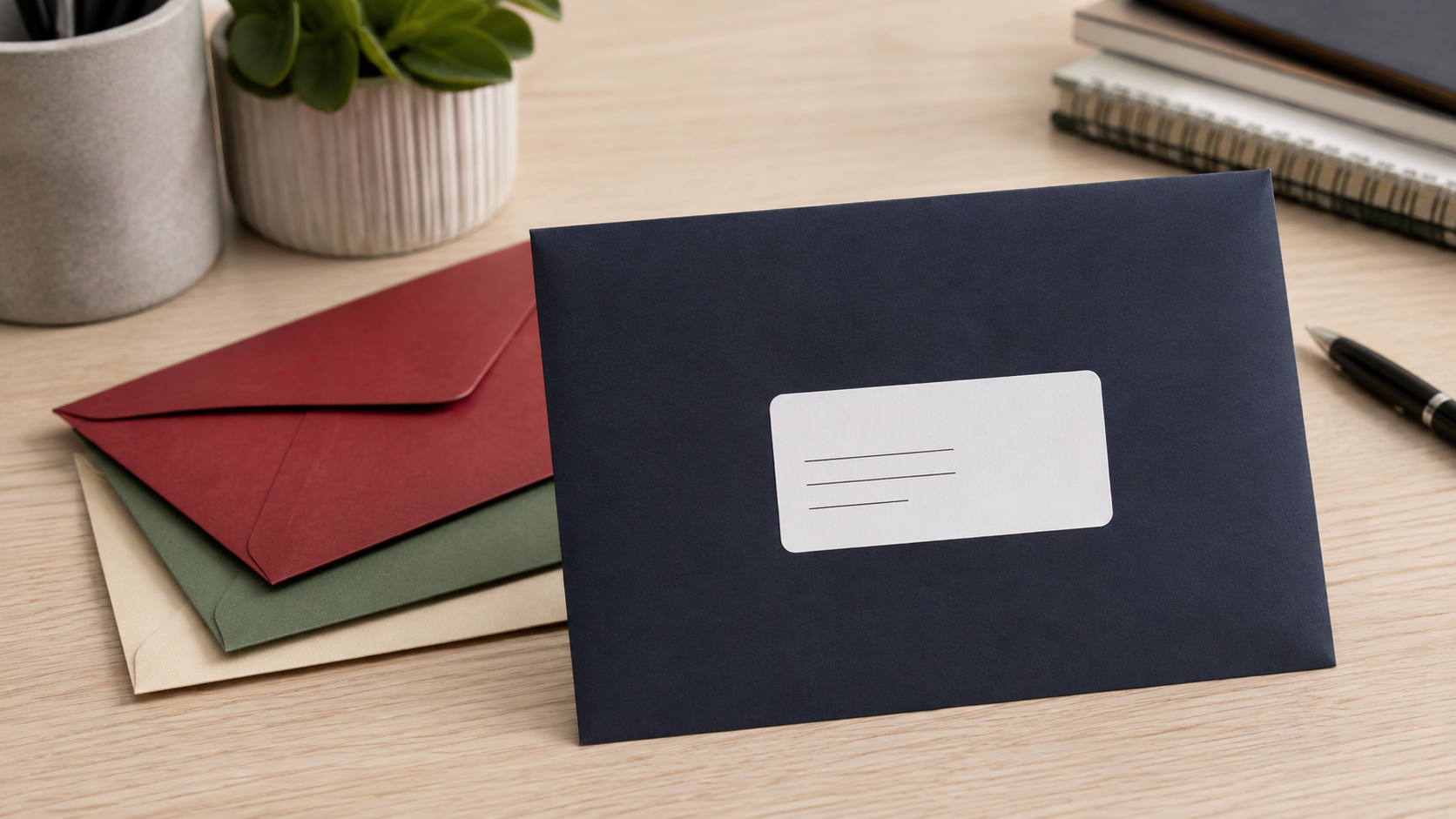
The Royal Mail coloured envelope guidelines focus primarily on readability. Royal Mail advises customers that an address needs to stand out against the colour of the envelope and suggests using a white label with black ink when necessary.
This does not mean coloured envelopes are banned. Instead, senders should make the address sufficiently clear for postal handling and sorting.
Why Does Royal Mail Recommend a White Label on Coloured Envelopes?
The main issue is address visibility.
Royal Mail states that it is important for the address to show clearly against the colour of an envelope. Its practical tip for coloured envelopes is therefore to use a white label with black ink.
The recommendation is particularly relevant for envelopes in colours such as:
- Dark red or burgundy;
- Navy blue;
- Dark green;
- Purple;
- Black;
- Heavily patterned designs.
Writing directly onto these envelopes with an ink colour that has weak contrast can make the recipient’s details more difficult to read.
The Consumer Council similarly advises people sending greeting cards or correspondence in dark-coloured or red envelopes to use a white label for the address.
Does a White Label Have to Be Used?

Royal Mail describes the white label as a tip for coloured envelopes, rather than stating that every coloured envelope must carry one regardless of its appearance.
The practical test is whether the address stands out clearly.
For example, black writing on a pale yellow or light blue envelope may already provide strong contrast. Black writing directly on a dark navy envelope, by comparison, would be much harder to distinguish.
When there is any doubt, a plain white label with clearly printed or handwritten black text is the safer approach.
Where Should the Address Go on a Coloured Envelope?
Royal Mail advises placing the name and delivery address in the bottom-left area of the front of the envelope or parcel.
The text should be clearly written or printed and left aligned.
A straightforward UK address could therefore appear as:
James Taylor
24 Example Street
MANCHESTER
M1 2AB
The postcode should be on the final line and written in capital letters.
Royal Mail also advises leaving a generous margin around the address instead of placing other writing or decoration immediately alongside it.
Where Should the Stamp Go?
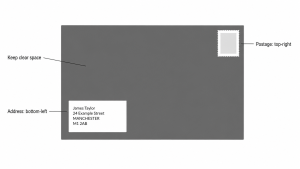
Correct postage should normally be placed in the top-right corner of the envelope.
That keeps the postage separate from the main delivery address and follows the standard layout expected on UK mail.
How Should Someone Address a Dark Coloured Envelope?
A practical approach for a navy, burgundy, black or similarly dark envelope is:
- Attach a clean white adhesive label to the front of the envelope.
- Write or print the recipient’s details in black.
- Keep the address left aligned.
- Place it towards the bottom-left area.
- Leave clear space around the label.
- Put the appropriate postage in the top-right corner.
This creates a high-contrast address area without forcing someone to abandon a decorative envelope.
Does Royal Mail Require Black Ink?
Royal Mail’s broader addressing advice says customers should use a pen or ink that is clear against the colour of the envelope or parcel. For coloured envelopes specifically, its published tip is to use a white label with black ink.
Black-on-white is therefore the simplest option because it provides strong contrast.
Decorative metallic pens, pale inks and colours close to the envelope’s background should generally be avoided for the delivery address when they make the text less distinct.
Can Red Envelopes Be Posted Through Royal Mail?
Yes. A red envelope does not automatically prevent a letter or card from being sent.
However, darker or saturated red backgrounds may provide poor contrast with some inks. UK consumer postal guidance specifically recommends a white address label when sending correspondence in dark-coloured or red envelopes.
For example, a Valentine’s Day or Christmas card in a deep red envelope could use a white rectangular label with the recipient’s address printed in black.
The decoration remains visible while the important postal information stays clear.
What Is the Correct Royal Mail Address Format?
Alongside the envelope colour, address formatting can affect how straightforward an item is to process.
Royal Mail advises senders to use a clear, readable handwriting style or printed font and to left-align address lines. It also recommends avoiding centred or stepped address layouts.
Recipient Name
The recipient’s name should appear first.
Including both the first name and surname can help identify the intended recipient.
Property and Street
The next line should normally contain the house number or property name and street.
For example:
18 Station Road
Locality
A village or local area can be included where relevant.
Post Town
Royal Mail recommends writing the post town in capital letters.
For example:
BRISTOL
Postcode
For UK destinations, the postcode should be the final line and written in capital letters.
For example:
BS1 2AB
A county is generally unnecessary where the rest of the address and postcode are correct.
Should a Return Address Be Added?

Royal Mail recommends including a return address so that an item can potentially be returned to the sender if it cannot be delivered.
Its guidance suggests writing “return address” on the back of the envelope followed by the sender’s address.
That can be particularly useful for:
- invitations;
- important correspondence;
- business letters;
- greeting cards;
- documents that would be inconvenient to lose.
Royal Mail also advises against writing telephone numbers or email addresses on the outside of an item, helping to protect the privacy of both sender and recipient.
Practical Examples of the Coloured Envelope Guidelines
Example 1: Dark Blue Birthday Card
A birthday card is being sent inside a navy envelope.
Writing the address directly onto the envelope using an ordinary black pen would create poor contrast.
Better approach: Attach a white label and print the address in black.
Example 2: Pale Pink Wedding Invitation
A wedding invitation uses a pale pink envelope and black printed text.
If the address is sharp, easy to read and clearly separated from the design, there may already be sufficient contrast.
A white label can still be used where the sender wants maximum clarity.
Example 3: Patterned Christmas Envelope
An envelope features a busy festive pattern containing red, green, gold and white areas.
Even though parts of the envelope are light, placing an address directly over the artwork could reduce readability.
Better approach: Use a plain white address label in an uncluttered area of the front.
Can Decorative Envelopes Cause Delivery Problems?
A decorative design does not automatically mean that mail will be delayed.
The issue arises when important postal information becomes difficult to distinguish.
Strong colours, patterns, reflective surfaces or elaborate handwriting can reduce clarity. Following Royal Mail’s basic addressing recommendations gives postal systems and delivery staff clearer information to work with.
The safest objective is simple: the address should be immediately identifiable as the delivery address.
Does Using a Coloured Envelope Cost More?
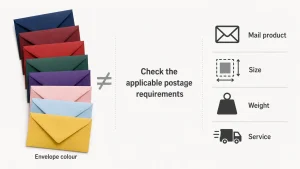
There is no indication in Royal Mail’s general addressing guidance that a normal letter attracts a higher postage price simply because its envelope is coloured.
Postage charges instead depend on factors such as the mail product selected and the item’s relevant size, weight and service requirements.
The white-label guidance relates to address readability, not a special coloured-envelope surcharge.
Senders should therefore check the current Royal Mail postage requirements for the item they intend to send rather than assuming its colour changes the price.
Checklist Before Posting a Coloured Envelope
Before putting a coloured letter or card into a postbox, the sender can quickly check that:
- the full recipient address is correct;
- the address is clearly visible against the envelope;
- a white label has been added if contrast is poor;
- black ink has been used on the white label;
- the address is left aligned;
- the postcode is present and clearly written;
- adequate clear space surrounds the address;
- the correct postage has been applied;
- a return address has been included where appropriate.
These checks are useful for birthday cards, wedding invitations, Christmas cards and ordinary correspondence alike.
Final Takeaway
The Royal Mail coloured envelope guidelines do not prevent UK customers from sending colourful birthday cards, invitations, Christmas cards or other correspondence.
The essential point is visibility. Royal Mail says the address should show clearly against the envelope and recommends a white label with black ink when using coloured envelopes.
Senders should also keep the address clear and left aligned, place it towards the bottom-left of the front, use the correct postcode and keep postage in the top-right.
A brightly coloured or decorative envelope can therefore still be used confidently. When the background makes the delivery information difficult to read, adding a simple white address label is the easiest way to follow Royal Mail’s practical guidance.
FAQs About Royal Mail Coloured Envelope Guidelines
Can you send coloured envelopes through Royal Mail?
Yes. Royal Mail provides guidance specifically for coloured envelopes. The main consideration is ensuring that the delivery address stands out clearly against the envelope colour.
Does Royal Mail require a white label on coloured envelopes?
Royal Mail recommends a white label with black ink as a practical tip for coloured envelopes. This is especially useful where the envelope colour would otherwise make the address difficult to distinguish.
Can Royal Mail deliver a black envelope?
A black envelope can be used, but writing the delivery address directly onto a black background may create readability problems. A white address label with black text provides much clearer contrast.
Can a red envelope be sent in the UK?
Yes. Red envelopes can be posted. For a dark or strongly coloured red envelope, using a white label is recommended by consumer postal guidance to make the address easier to read.
Where should the address be written on a Royal Mail envelope?
Royal Mail advises putting the recipient’s name and address towards the bottom-left corner of the front of the envelope or parcel.
Can an address be printed rather than handwritten?
Yes. Royal Mail permits a clear, easy-to-read handwriting style or printed font. Whichever method is used, sufficient contrast and a straightforward layout are important.
Should the postcode be written in capitals?
Royal Mail recommends writing the UK postcode in capital letters on the final line of the address.
Can gold or silver pens be used on dark envelopes?
The central requirement is readability, but metallic or decorative inks may offer inconsistent contrast depending on the background and lighting. A white label with black ink is the more straightforward option for a dark envelope.
Does a coloured envelope need extra postage?
Royal Mail’s coloured-envelope addressing guidance does not introduce a special postage charge based solely on envelope colour. The applicable postage depends on the relevant postal product and characteristics of the item.